
Quick Summary
Corporate event catering is planned by first defining the event's goal, then building a per-person budget, estimating portions from confirmed RSVPs, and choosing a menu and service style that fits the event type. Start with one sentence describing the outcome you want, since that guides the menu, service and spend.
- Write one sentence on the outcome you want before choosing any dishes.
- Divide the total budget by confirmed guest numbers to get a working cost per person.
- Compare quotes line by line, checking whether each is inclusive or exclusive of GST.
- Set aside roughly 5 to 10 per cent of the total as contingency for headcount changes.
- Order against confirmed RSVPs, not the invite list, and diarise the caterer's final-number cut-off.
Table of Contents
- Set Your Event Goals and Catering Budget
- How Much Food to Order for a Corporate Event
- Corporate Event Catering Menu Ideas by Event Type
- Corporate Catering Dietary Requirements and Allergen Controls
- Corporate Event Catering Checklist and Service Timeline
- Booking Your Corporate Catering with Ninin's Indo Street Food
- Frequently Asked Questions
Set Your Event Goals and Catering Budget
Corporate event catering works best when you decide what the food is for before you choose a single dish. A staff training day with a working lunch needs something very different from an end-of-year function where people should linger, mingle and relax. Start by writing one sentence about the outcome you want, then let that sentence guide the menu, the service style and the budget.
Defining the outcome you want from the food
Ask what the food should achieve. Common goals include keeping people in the room through a long session, giving a client-facing event a polished feel, or simply rewarding a team with a generous, shared meal. Each goal points to a different catering style.
Many businesses find that a clear goal simplifies every later decision, from portion sizes to the number of service staff. Write the goal down and share it with whoever signs off on the budget.
Building a per-person budget worksheet in AUD
Start with the total budget, then divide it by your confirmed guest numbers to get a working cost per person. Pricing depends on quantity, dates and delivery, so request a written quote from Ninin's Indo Street Food for your specific headcount and event type. Once you have that quote, build a worksheet that separates the cost lines most quotes bundle together. A practical structure is:
- Food and beverage per head, the caterer's quoted rate multiplied by confirmed guests. This is usually the largest line for most functions.
- Service and labour, buffet attendants, plated service staff or bar staff are often charged per hour with a minimum call time, so a four-hour event may attract a five-hour minimum.
- Equipment and hire, chafing dishes, warming trays, serving utensils, crockery, cutlery, glassware, linen and furniture. Confirm whether these are included in the per-head rate or quoted separately.
- Delivery, setup and breakdown, often a flat fee that varies by distance, access (stairs, loading docks, lift bookings) and the time window the venue allows.
- Venue or access charges, some venues levy a kitchen use fee, a corkage fee if you supply your own drinks, or a cleaning bond.
- GST, confirm whether each quote is inclusive or exclusive of GST before you compare suppliers, because a 10 per cent difference changes the ranking.
- Contingency, set aside roughly 5 to 10 per cent of the total for last-minute headcount changes, extra servings or equipment substitutions.
Keep the worksheet in a spreadsheet with one column per quote so you can compare suppliers line by line rather than on the headline per-head figure. Update it each time RSVPs firm up.
Watch out: the most common source of budget variance is headcount drift, not menu price, a handful of late acceptances on a plated meal can push you into a new per-head tier, so track RSVPs against your quoted minimums weekly and confirm the cut-off date the caterer needs for final numbers.
Allocating spend across the event
A useful rule of thumb is to decide early what share of the budget goes to food versus everything else. For a working lunch, food typically dominates and service can be minimal. For a client-facing evening function, service, equipment and presentation absorb a larger share, and the food budget per head may need to rise to match the setting. Write the split down before you request quotes so you can tell a caterer which lines are fixed and which are flexible.
How Much Food to Order for a Corporate Event
Ordering the right quantity is one of the hardest parts of corporate event catering, because attendance is rarely certain. Plan around confirmed numbers, then add a buffer for late registrations and walk-ins. Ask your caterer how they handle over-ordering and what happens to leftovers. Keeping inventory records current through digital stocktaking for catering can also help you compare planned quantities with actual use and make better estimates for future events.
Estimating portions against attendance uncertainty
A practical approach is to order against the number of people you expect to eat, not the number invited. Build that number in three steps:
- Start with confirmed RSVPs. This is your base. Do not order against the invite list.
- Apply an expected attendance rate. For a free internal event with a compulsory element, most practitioners find attendance lands close to the RSVP count. For optional events, after-work drinks, a lunchtime session with no agenda pressure, a common pattern is for 10 to 20 per cent of acceptances not to attend. Ask your caterer what rate they see for events like yours; they plan against it every week.
- Add a walk-in buffer only where it applies. If the event is open to a floor or a building, add a small buffer of a few servings. If it is ticketed or gated, you can usually skip it.
Then convert the eating number into portions. For a buffet with rice and several mains, plan one substantial serve per person plus a small margin, because people tend to take a little of each dish. For platters and canapés, plan a set number of pieces per person, a common starting point is four to six pieces per person for a short networking break and eight to ten for a standing function that replaces a meal.
Adjusting orders as RSVPs change
Build a simple RSVP tracker with columns for invited, accepted, declined, dietary requirements and confirmed eating number. Update it weekly, and diarise the caterer's final-number cut-off date, most need final numbers several business days before the event, and changes after that point may be charged in full or not accepted at all.
Watch out: if your event has a fixed start and a short serving window, the food must stretch across a compressed period, so under-ordering bites harder than at a long grazing event, for a sit-down lunch, err toward the higher end of the buffer and confirm the caterer can replenish trays during service.
Matching quantity to the shape of the event
Portion planning also depends on whether the food is the main meal or a light refreshment. A full buffet with rice and several mains should be planned as a substantial meal, while platters of snacks suit a short break. A lunchtime function with a fixed start usually sees most guests eat at once, which means the food must stretch across a shorter window.
Corporate Event Catering Menu Ideas by Event Type
The right menu depends on the event. A team lunch, a client presentation and a staff celebration each call for a different balance of dishes, formality and pace.
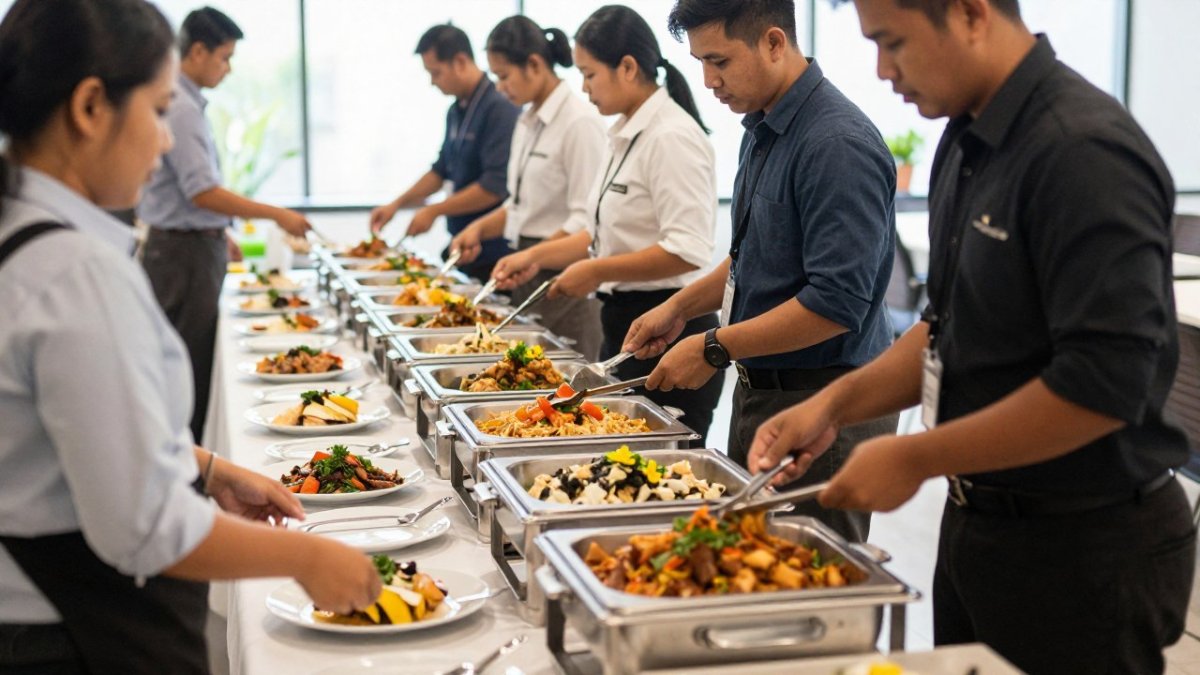
Shared Indonesian buffets suit team lunches and staff functions well. Dishes served in warm trays encourage people to chat while they serve themselves.
Ninin's Indo Street Food offers buffet service, which suits crowd-style functions.
Corporate Catering Dietary Requirements and Allergen Controls
Dietary needs are now a standard part of corporate catering planning. Collect requirements in advance through your RSVP form, asking specifically about allergies, intolerances, vegetarian, vegan, gluten-free and dairy-free diets.
Labelling matters as well. Ask your caterer how dishes are prepared, whether shared utensils are used, and how they separate ingredients that contain common allergens.
Raise any specific dietary needs with the team early in the planning process.
Corporate Event Catering Checklist and Service Timeline
A simple checklist keeps the project on track. Work through these items in order:
- Confirm the event goal and the total budget in AUD
- Lock in the confirmed guest numbers and collect dietary requirements
- Choose the service style: buffet, platters or plated meal
- Select menu items and confirm portion quantities
- Agree on delivery time, setup location and power or heating needs
- Confirm staffing and who will manage serving
- Arrange a contingency plan for late changes or equipment problems
- Confirm invoicing, deposits and cancellation terms in writing
- Review leftovers, waste and feedback after the event
Build a service timeline working backwards from the start time. Allow for the caterer to arrive, set up and have food ready before guests arrive, then plan a clear window for serving and a finish time for clearing away.
Booking Your Corporate Catering with Ninin's Indo Street Food
When you are ready to book, Ninin's Indo Street Food can help you plan your corporate event with an authentic Indonesian menu, including buffet service and a custom food trailer.
To get started, contact the team with your event date, headcount and goals. Pricing depends on quantity, dates and delivery, so request a current quote from the website for your specific requirements.
Frequently Asked Questions
How do you plan catering for a corporate event?
Start by confirming the event goal, the number of guests, the budget and the time window. Then choose a service style such as buffet, plated or food stations, match the menu to the formality of the event, and confirm the serving schedule with the venue. Book early, ask for a written quote that lists what is included, and agree on who handles setup, staffing and cleanup. Ninin's Indo Street Food provides catering for corporate functions in Adelaide, and pricing depends on quantity, date and delivery, so request a current quote on the website.
How much food should you order for a corporate event?
Confirm your guest numbers with RSVPs first, then plan portions based on whether food is the main meal or a refreshment. As a planning rule, a main meal usually needs a generous portion per guest, while a function with drinks and light snacks needs less. Order slightly above confirmed numbers to allow for late attendees, and ask the caterer whether leftovers can be packed. Clear agreement on the final guest count, usually a few days before the event, helps control both shortages and food waste.
How do you choose a menu for a corporate event?
Match the menu to the event type, the length of the function and the guest profile. A morning training session suits lighter options, while an end-of-year function may call for a shared buffet with a few substantial dishes. Offer a balance of mild and bolder flavours, include vegetarian options, and keep the menu simple enough that service runs smoothly. Indonesian dishes such as shared rice and noodle dishes work well for buffets because they suit groups.
How do you cater for dietary requirements at a corporate event?
Collect dietary requirements and allergies during registration, not on the day. Ask specifically about vegetarian, vegan, gluten-free, dairy-free and nut allergies, and flag any severe allergies to the caterer. Label every dish clearly, keep allergen-free items separate to avoid cross-contamination, and confirm the approach with the caterer in writing.
What catering style works best for a corporate function?
A buffet suits large groups and mingling, a plated meal suits formal dinners and awards nights, and food stations suit networking events where guests move around. A food trailer can add a casual feature to festivals or staff days. Choose the style that fits your timeline and room layout, since buffets need enough table space and plated meals need more staff. Discuss the venue layout with your caterer before confirming.
What should a corporate catering checklist include?
A useful checklist covers the event goal, budget, confirmed guest numbers, dietary requirements, menu and service style, serving times, venue access, power and space needs, staffing, equipment such as serving dishes and utensils, setup and breakdown times, and a named contact on the day. Add a contingency item for a late change in numbers or delayed delivery, and confirm the final details at least a few days before the event.
When should you book corporate event catering?
Book as early as you can, particularly for end-of-year functions and popular dates, as caterers fill up quickly during peak seasons. Once the date and approximate headcount are known, request a quote and lock in the booking with a written confirmation. Final numbers can usually be confirmed closer to the event, so ask the caterer what their deadline for changes is.
