
Table of Contents
- What Small Backyard Wedding Catering in Adelaide Actually Involves
- Quick Comparison: Adelaide Caterers for Intimate Backyard Weddings
- Backyard Wedding Catering Logistics: Space, Power and Access
- Wedding Catering Cost Per Person: How to Build a Realistic Budget
- Food Trailer Wedding Catering: What Works in a Backyard
- Menu Variety, Grazing Tables and Dietary Requirements
- Questions to Ask a Wedding Caterer Before You Book
- Conclusion: Choosing the Right Fit for Your Backyard Wedding
- Frequently Asked Questions
Last Updated: October 12, 2026
What Small Backyard Wedding Catering in Adelaide Actually Involves
Wedding catering for small backyard parties Adelaide couples plan is not a scaled-down big reception, it is a different job, built around a home kitchen, a narrow side gate and a guest list you can count on two hands.
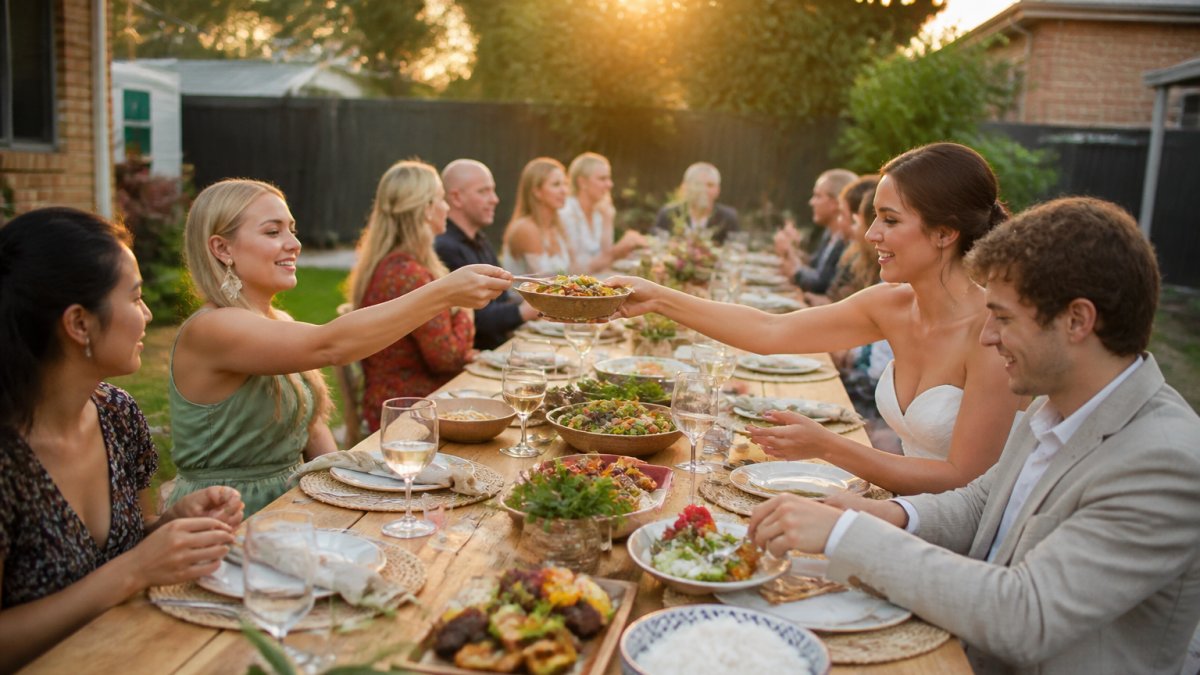
Backyard catering splits into two models. Full-service brings staff, cooking equipment, serving ware and cleanup; drop-off delivers food ready to serve and you handle the rest.
Logistics, not the menu, change the planning. A standard domestic circuit will not run commercial cooking equipment, and a side gate under 900mm rules out most trailers. Settle those two facts before you fall in love with a menu.
Quick Comparison: Adelaide Caterers for Intimate Backyard Weddings
Most comparison pages list providers and stop there, useless when your venue is a suburban backyard with a narrow side gate and 35 guests.
Use the criteria below as your shortlisting framework. Then apply it to whichever providers you contact, including us.
The five criteria that separate backyard-capable caterers from the rest
- Minimum guest count. Some full-service caterers set a floor (commonly 50-80 guests for plated service) because staffing and equipment costs do not scale down. Drop-off and food-truck operators have far lower or no minimums. Ask this first, it eliminates more providers than any other question.
- Service area and travel. Confirm the caterer's standard service area covers your suburb, and whether a travel or delivery fee applies beyond it. A provider based 45 minutes away may add a surcharge or decline outright.
- What is included versus extra. Staffing, serving ware, crockery, cutlery, glassware, linen, setup, pack-down and rubbish removal are frequently quoted separately. A lower headline rate with five add-ons is not cheaper.
- Site requirements. Does the caterer need mains power, water, level ground or a minimum access width? A trailer operator needs a clear path and level standing space; a drop-off provider needs almost nothing.
- Dietary handling. Ask how they manage coeliac requirements, anaphylaxis-risk allergies and vegan guests, specifically whether those dishes are prepared separately and labelled.
How the main service formats compare for a small backyard wedding
| Format | Typical guest-count fit | What the caterer provides | What you provide | Site demands |
|---|---|---|---|---|
| Drop-off | 15-60 | Food delivered ready to serve, often in recyclable or returnable trays | Serving dishes, heating, tables, cleanup | Minimal, a kitchen bench and bench space |
| Grazing table / platters | 20-80 | Styled platters or a grazed table, sometimes with setup | Table, linen, refrigeration before service | A long table and shade |
| Food trailer | 30-100 | Self-contained cooking and service from the trailer | Level standing space, access path, power or gas | Level ground, clear access, power or gas |
| Staffed buffet | 30-120 | Staff, chafing dishes, serving ware, replenishment, cleanup | Tables and space for the buffet line | Power for chafing fuel or warming, space |
| Plated / seated | 40+ | Kitchen team, waitstaff, crockery, cutlery, glassware | Seating for every guest, often a marquee | Substantial space, power, access for equipment |
Applying this to providers you contact
Ninin's Indo Street Food is our own business, so treat our row accordingly. We run a custom food trailer and buffet service, take backyard weddings from around 30 guests upward, and offer drop-off for smaller lists.
Food safety guidance for catering and events
Backyard Wedding Catering Logistics: Space, Power and Access
Backyard wedding catering lives or dies on three measurements. Get them wrong and even the best caterer cannot save the day.
- Gate and path width: Walk the route a trolley would take and measure the narrowest point, not the widest.
- Power: Check whether the circuit you plan to use shares a board with the house air conditioning. Ask an electrician if unsure.
- Flat serving space: A trailer needs level ground; sloping lawns and soft turf after rain cause problems.
- Weather cover: Have a wind and rain plan that does not involve moving 60 plates indoors at the last minute.
- Rubbish and water: Confirm where waste goes and whether the caterer needs a water connection.
Wedding Catering Cost Per Person: How to Build a Realistic Budget
Wedding catering cost per person depends on service style, menu complexity, guest count and site logistics, so any caterer quoting a flat figure before asking about your event is guessing.
Indicative per-person ranges by service style
These are broad market ranges for small private events, not quotes. Your final figure will sit inside or outside them depending on the factors below.
| Service style | Indicative per-person range | What typically drives the figure |
|---|---|---|
| Drop-off catering | Lower end of the market | Menu complexity, portion size, packaging, delivery distance |
| Grazing table / platters | Mid-range | Premium ingredients (cured meats, cheeses, seafood), styling, quantity per guest |
| Food trailer | Mid-range | Menu, service window length, whether the trailer is self-sufficient or needs power |
| Staffed buffet | Upper mid-range | Staff hours, serving ware, chafing equipment, replenishment, cleanup |
| Plated / seated | Highest | Kitchen labour, waitstaff ratios, crockery, cutlery, glassware, multiple courses |
The costs that sit outside the per-person rate
This is where small-event budgets blow out. Ask every caterer which of these are included and which are extra:
- Delivery and travel fees. Often charged by distance from the caterer's base, or as a flat call-out fee.
- Staffing. Charged per staff member per hour, usually with a minimum shift length (four hours is common). A 30-guest wedding may still need two staff.
- Equipment hire. Crockery, cutlery, glassware, linen, chafing dishes and urns are frequently hired separately.
- Setup and pack-down. Some include it; others charge for time on site before and after service.
- Rubbish removal. Rarely included, and easy to overlook when hosting at home.
- Minimum spend. Many caterers set a floor regardless of guest numbers, a 25-guest wedding may still be charged at a 40-guest minimum.
- Public holiday and weekend surcharges. Worth asking about if your date falls on a long weekend.
How to build your budget in the right order
- Set a guest count range, not a single number. Caterers quote on a band, and your final headcount firms up in the last fortnight.
- Choose the service style first. It is the biggest lever on cost, moving from plated to drop-off changes the budget more than any menu swap.
- Get the inclusions list in writing. Compare quotes on what is included, not the headline rate.
- Add drinks as a separate line. Many couples forget this, and it is often 15-25% of the food budget.
- Ring-fence a contingency. Small events change shape in the final fortnight, extra guests, a wet-weather marquee, an extra staff member.
- Confirm the minimum spend and cancellation terms before paying a deposit.
What changes the final quote
Two couples with identical guest counts often receive very different quotes because of site access, service window length, dietary requirements and date.
For current pricing, get an instant quote from us rather than working from a number someone mentioned at a barbecue.
Food Trailer Wedding Catering: What Works in a Backyard
Food trailer wedding catering works in a backyard when the site has level ground, a clear access path and enough power or gas for the trailer to run independently.
The trailer format suits backyard weddings for practical reasons. Guests order and collect their own food, spreading service over a relaxed window instead of a rigid sitting.
Where it falls short is tight spaces. If your only access is a narrow side path, a trailer will not fit, and a buffet or drop-off setup is the better answer.
Menu Variety, Grazing Tables and Dietary Requirements
Menu variety matters more at a small wedding than a large one, because you cannot hide a dish nobody likes behind a crowd. A grazing table handles the arrival hour, then a shared main course carries the meal.
On dietary requirements, collect them properly. Send a short form with the RSVP asking specifically about vegan options, vegetarian options, allergies and intolerances. Vague answers like "a few dietary issues" create real risk on the day.
Common approaches that work:
- A clearly labelled vegan main, not a plate of side dishes
- Gluten-free versions of the core dishes, prepared separately
- Dairy-free options across the shared menu so nobody feels singled out
- Written allergen information for every dish, available to guests
Questions to Ask a Wedding Caterer Before You Book
Questions to ask a wedding caterer should cover access, inclusions, staffing and what happens when something goes wrong. Ask before you pay a deposit, not after.
- What is your minimum guest count, and what happens if numbers drop?
- Is staffing included, or is it an extra line on the quote?
- Who sets up and who cleans up, and by what time?
- What is your policy on leftovers?
- How do you handle allergies and cross-contamination?
- What is your cancellation and postponement policy?
- Can you work with a backyard that has limited power?
- Will the same team who quoted turn up on the day?
The last one matters more than people expect. A caterer who is excellent at quoting and inconsistent at delivering is a common complaint in event planning.
Conclusion: Choosing the Right Fit for Your Backyard Wedding
The hardest part of backyard wedding catering is not finding a caterer. It is finding one whose service style matches your actual site, guest count and budget without overselling you something your garden cannot support.
At Ninin's Indo Street Food, we bring authentic Javanese family recipes, generous portions and flexible options including a custom food trailer and buffet service. Packages are built around your budget and event type, whether an intimate gathering of 30 or a celebration of 80.
Frequently Asked Questions
How much does it cost to feed 50 wedding guests?
There is no single figure, because wedding catering cost per person depends on the service style, menu, and inclusions. Drop-off or buffet catering usually costs less per head than a fully staffed sit-down dinner. Ask each caterer for a written quote covering food, delivery, staffing, and equipment hire, then compare on a per-person basis. Ninin's Indo Street Food builds custom packages around your budget, so request a quote with your guest count for current pricing.
What catering style works best for a small backyard wedding?
For 30 to 80 guests, buffet and food trailer service usually work best. A buffet lets people eat at their own pace, and a food trailer brings its own cooking setup, which matters when a home kitchen has limited space. Sit-down dinners suit smaller groups where you want a more formal feel. Many couples mix a grazing table on arrival with a buffet or trailer for the main meal.
Can a food trailer cater a wedding in a backyard?
Yes, if the yard has clear vehicle access and enough flat, stable ground. Check the gate width, any overhead branches, and whether the trailer can park close to where guests will eat. Food trailer wedding catering also needs a power source, though many trailers run their own generator. Confirm access details with your caterer before booking so there are no surprises on the day.
What should you ask a wedding caterer before booking?
Ask about minimum guest numbers, minimum spend, and what the quote includes: delivery, setup, staffing, serving equipment, and cleanup. Confirm how they handle dietary requirements such as vegan, vegetarian, gluten-free, and dairy-free guests. Also ask about booking lead times, deposit and cancellation terms, and whether they hold public liability insurance. Getting these answers in writing makes comparison much easier.
How do you plan catering when a home kitchen has limited space?
Choose a caterer who arrives with their own cooking and warming equipment, such as a food trailer or a full-service buffet setup. This removes the need to store, reheat, or plate food in your kitchen. Clear bench space, keep power points free, and set up a separate table for drinks so guests stay out of the prep area. Confirm with your caterer what they need from you beforehand.