
Last Updated: October 25, 2026
Quick Summary
A small event catering minimum is the lowest guest count or total spend a caterer will accept, set to cover food costs, prep time, and delivery logistics. Most operators set minimums between 10-15 people, though some work with smaller groups depending on event type and location.
- Most Adelaide caterers use one of three minimum structures: minimum guest count, minimum spend, or minimum spend plus delivery charges.
- Near a minimum threshold, the per-person rate is usually higher because fixed costs like fuel, setup time, and staff hours don't shrink with guest count.
- A transparent quote should itemise food cost per person, delivery fee, setup and pack-down fee, equipment hire, staffing, and any small-order surcharge separately.
- Compare the total delivered cost divided by confirmed guest count across quotes, not headline per-person rates, to find the true best value.
- Strategies to meet a minimum include topping up with add-ons, switching service format, choosing off-peak dates, or reducing the menu rather than the guest list.
Table of Contents
- Understanding small event catering minimum orders
- How catering for 40 people works with minimums
- Catering cost per person and how minimums affect pricing
- Catering portion sizes: what to expect and how to order
- Questions to ask a caterer before you book
- Practical strategies to meet a caterer's minimum order
- Getting your catering quote and confirming details
- Frequently Asked Questions
Understanding small event catering minimum orders
A small event catering minimum is the lowest guest count or total spend a caterer will accept, set to cover food costs, prep time, and delivery logistics.
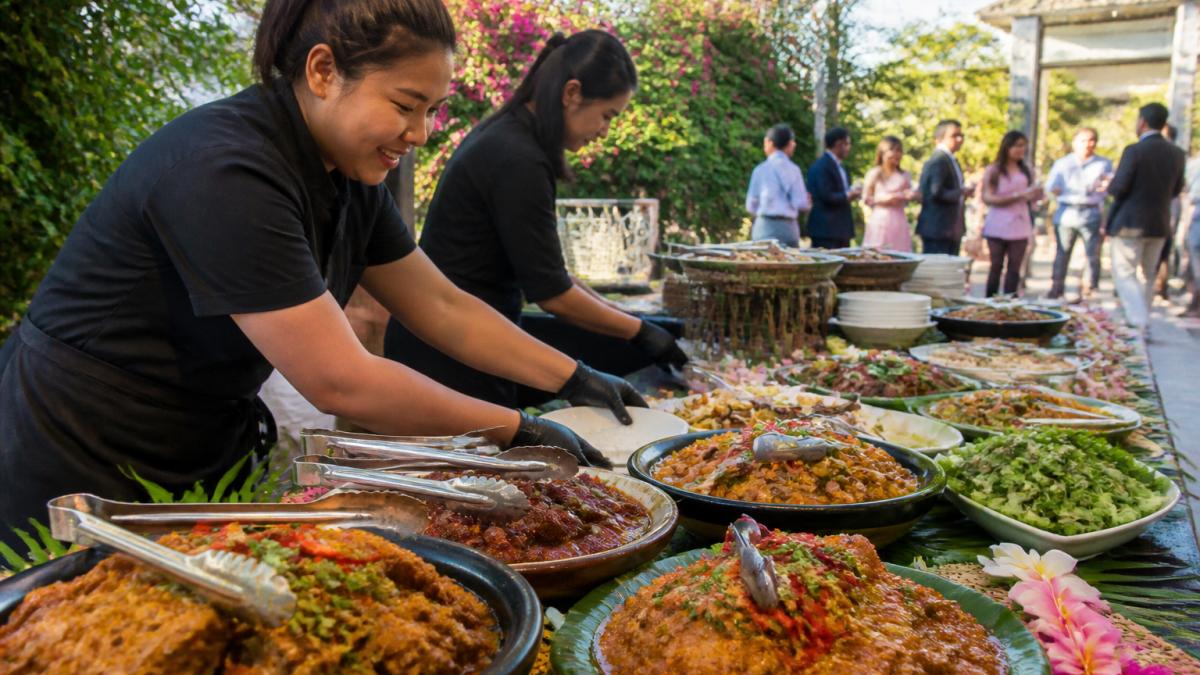
At Ninin's Indo Street Food, we believe small gatherings deserve authentic, generous catering without compromise.
Minimums across Adelaide caterers reflect different business models, a food truck operator may work with smaller groups than a full-service company.
How catering for 40 people works with minimums
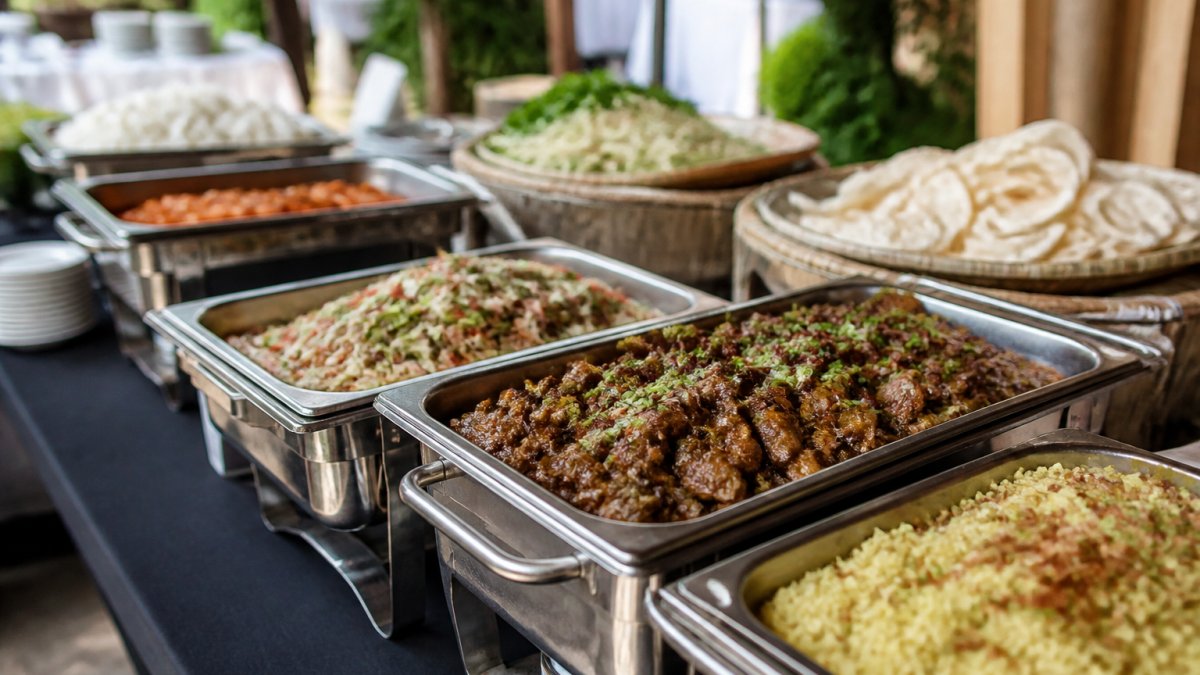
Catering for 40 people sits comfortably above most minimum thresholds, giving you genuine flexibility in vendor choice. Portion planning becomes more forgiving, per-person costs often drop slightly, and most Adelaide operators offer buffet setup, plated service, or food truck delivery. Dietary accommodations, menu tweaks, and preferred dates come more easily, and you calculate per-person cost against a solid headcount rather than chasing a minimum spend.
Catering cost per person and how minimums affect pricing
Catering cost per person and minimum orders are different numbers, and confusing them is the most common budgeting mistake for small events. A per-person rate tells you what each guest costs once you're inside the caterer's accepted range; a minimum order is the floor you must reach before they'll take the booking. See our Indonesian buffet catering menu, pricing structure, and how per-person costs relate to minimum orders.
The three minimum types you will encounter
Most caterers in the local market use one of three minimum structures, and some combine them:
- Minimum guest count. The caterer will not accept a booking below a set headcount, commonly 10, 15, or 20 guests for drop-off and buffet formats. Below that number, the fixed costs of preparation and transport outweigh the order value.
- Minimum spend. A dollar floor rather than a headcount floor, for example, a $450 or $600 minimum order value. This suits grazing tables, platters, and packaged meal boxes where the guest count is flexible but the kitchen still needs a viable order size.
- Minimum spend plus delivery. The spend floor applies to food only, with delivery, setup, and equipment hire charged on top. This is where small orders quietly become expensive, because a $300 food order can attract a $60-$120 delivery fee and a setup charge before any staff time is added.
A fourth pattern is emerging among food-truck and casual operators: no formal minimum, but a minimum order value per drop or a surcharge below a certain headcount. Always ask which structure applies, a low guest minimum with a high delivery fee can cost more than a higher spend minimum with free local delivery.
How fixed costs drive the per-person premium
Near a minimum threshold, the per-person rate is usually higher: fuel, setup time, staff hours, equipment cleaning, and admin don't shrink with guest count. One van and two staff for a 12-person lunch costs nearly the same as for 30, so it's spread across fewer plates. Many caterers step the per-person rate down at defined headcounts, higher for 10-19 guests, mid for 20-39, lower from 40 upward.
What a small-order quote should itemise
A transparent quote for a small event should break out at least these lines:
- Food cost per person, multiplied by the confirmed headcount
- Delivery fee, stated as a flat amount or a distance-based charge
- Setup and pack-down fee, if the caterer arranges the buffet or grazing table
If a quote arrives as a lump sum, ask for the breakdown. A caterer who won't itemise delivery, setup, and equipment is usually folding those costs into the per-person rate, making comparison impossible.
The comparison that actually matters
Don't compare headline per-person rates. Compare the total delivered cost divided by the confirmed guest count. A lower per-person rate with delivery, setup, and equipment on top can cost more per head than a higher all-inclusive rate.
Australian Competition and Consumer Commission guidance on pricing and quotes sets out consumer rights around advertised prices and component pricing, which is useful when a quote separates food, delivery, and fees.
Catering portion sizes: what to expect and how to order
Portion sizes vary by event type, meal timing, and menu style, a finger-food reception needs different quantities than a sit-down dinner. For a small event catering minimum order, portion planning is critical because you can't easily add food mid-event.
Eat Breadless's guide to event catering for small events notes that drop-off catering (where the caterer delivers and leaves) suits intimate gatherings of 10-50 guests well, particularly when you want generous, unfussy food that guests serve themselves.
Indonesian catering features generous portions of slow-cooked, shareable dishes. At Ninin's Indo Street Food, our family recipes prioritise abundance and flavour over minimalist plating, generosity built into our approach to small event catering minimum orders.
Questions to ask a caterer before you book
Before committing, ask these questions to avoid surprises: Find answers to common questions about catering, menus, packages, and how we work.
About minimums and pricing: What is your minimum order size or minimum spend?
About the menu and customisation: Can you accommodate dietary requirements (vegetarian, vegan, gluten-free, dairy-free, nut-free)?
About logistics: What time do you arrive and depart?
About reliability: How long have you been operating?
About the food itself: Where do you source ingredients? How far in advance do you prepare dishes?
Australian Consumer Law guidance on service contracts recommends getting all terms in writing, including cancellation conditions, deposit requirements, and what happens if the caterer can't fulfil the order.
Practical strategies to meet a caterer's minimum order
When the caterer you want has a minimum slightly above your guest count, you have more options than adding people. Choose the strategy that adds value rather than padding the bill.
1. Top up with high-value add-ons
Instead of negotiating the minimum down, meet the spend floor with items that improve the event: a dessert platter, a grazing board for arrival drinks, non-alcoholic beverages, or take-home meal boxes. Best when the gap is small, say, a $150-$250 shortfall. Trade-off: add-ons increase total cost, so only use this when the extra items genuinely fit.
2. Switch service format
Minimums aren't uniform across formats. Drop-off catering, shared platters, and grazing tables usually carry lower minimums than staffed buffet or plated service because labour and equipment costs are lower. If a caterer's staffed minimum is too high, ask whether the same kitchen offers a drop-off or platter version at a lower threshold. Trade-off: you take on more setup and serving, often fair for a 15-25 person gathering, less so for a formal seated dinner.
3. Combine events or drops
If you are planning two small gatherings close together, a Friday team lunch and a Saturday family lunch, for example, ask whether the caterer will treat them as a single booking for minimum purposes. Some will, especially if both deliveries fall on the same route or within the same week. Trade-off: the events must be close in date and location, and the caterer may still charge two delivery fees.
4. Choose an off-peak date or time
Minimums and surcharges often flex with demand. A weekday lunch, an afternoon function, or a Sunday event may carry a lower minimum or no small-order surcharge compared with a Saturday evening in peak season. Ask directly whether the minimum changes by day or season, many caterers apply quieter-period flexibility informally. Trade-off: you lose the preferred date, so only worth it if your event is date-flexible.
5. Book early and confirm the headcount late
Booking well ahead gives the caterer planning certainty, which sometimes earns flexibility on a borderline minimum. Equally useful: ask how late you can confirm the final headcount, a caterer who allows confirmation a week out lets you invite a few extra guests if numbers are short. Trade-off: early booking usually means an earlier deposit, so confirm cancellation terms first.
6. Reduce the menu, not the guest list
A shorter menu, fewer dishes, no custom modifications, simpler sides, lowers the caterer's preparation cost and can bring a spend minimum within reach. This suits casual events where guests expect generous, straightforward food. Trade-off: less variety, so check the simplified menu still covers vegetarian, gluten-free, and allergen-friendly guests.
Choosing the right format for a small headcount
The strategy only works if the service format fits the event. Use this quick decision guide:
- Under 15 guests, casual: drop-off platters or packaged meal boxes. Lowest minimums, least fuss, and the food still feels generous.
- 15-30 guests, social: shared platters or a grazing table. Lower minimums than staffed service, and the format suits mingling.
- 15-30 guests, formal: staffed buffet. Higher minimum, but you get setup, serving, and pack-down included.
What not to do
Do not ask a caterer to waive their minimum outright. It signals that you see their cost structure as negotiable when it is not, and it rarely works.
Internal link: Fresh Food. On-Site. Real Javanese shows how the kitchen structures packages across drop-off, platter, and staffed formats, so you can match the service style to your headcount before you commit.
Getting your catering quote and confirming details
Once you've narrowed your choice, getting a quote and locking in details requires precision:
Provide clear information: Tell the caterer your guest count, event date, venue location, setup time, dietary requirements, and menu preferences, the more specific, the more accurate the quote.
Confirm dietary and allergen handling. Confirm in writing how the caterer will prevent cross-contamination and label dishes.
Agree on timing. Specify arrival time, setup duration, service format, and departure time.
Discuss contingencies. Get the caterer's policy in writing for reducing guest count or adding items.
Secure the booking. Most caterers require a deposit (typically 25-50%) to hold your date.
Internal link: Fresh Food. On-Site.
Small event catering minimum orders exist for genuine business reasons, but they don't have to limit your options. At Ninin's Indo Street Food, we've spent thirteen-plus years making small events feel generous and stress-free. Let's talk about your event and find the approach that works for you: authentic Indonesian food, flexible service, and reliability your guests will notice.
Frequently Asked Questions
How much catering should I order for 40 people?
For 40 people, most caterers recommend ordering based on the event type and duration. A typical guideline is 80-120 grams of protein per person for a main course, plus sides and desserts. If your event runs 2-3 hours with finger food or shared platters, plan for 150-200 grams per person total. Always confirm portion sizes and serving style with your caterer, as generous servings differ from standard portions. Ninin's Indo Street Food specialises in generous portions, so discuss your expectations when requesting a quote.
Do caterers have minimum order requirements for small events?
Yes, most caterers set minimum orders between 10-15 guests. These minimums help caterers cover preparation, delivery, and staffing costs. Some operators may waive or adjust minimums for events in their local area or during off-peak dates. If your guest count falls below the minimum, ask whether you can add menu items, extend the event duration, or combine offerings to meet the threshold. Ninin's Indo Street Food works with small to medium events and can discuss flexible options when you request a quote.
What should I ask a caterer before booking?
Ask about their minimum order quantity and spend, delivery and setup fees, payment terms and deposit requirements, cancellation policy, dietary requirements they accommodate (vegetarian, gluten-free, nut-free), final guest count confirmation deadline, and whether they provide serving staff or equipment. Request references or photos from recent events. Clarify what's included in the quoted price and whether gratuity is expected. These questions to ask a caterer help you avoid surprises and ensure the service matches your event needs and budget.
How does catering cost per person change with smaller guest counts?
Catering cost per person typically increases for smaller events because fixed costs (travel, setup, staffing) are spread across fewer guests. The per-person cost can vary significantly based on the number of guests. Minimums exist partly to make small events economically viable for caterers. To reduce per-person costs, combine menu items, choose simpler service styles (drop-off versus full staffing), or book during off-peak times. Always ask for an itemised quote so you understand which costs are fixed and which scale with guest count.
