
Table of Contents
- Why Getting Catering Portions Right Matters
- The Core Formula: How to Calculate Catering Portions Per Person
- Food Quantities for 100 Guests: A Worked Example
- Buffet Portion Sizes Per Person: Adjusting for Service Style
- Using a Catering Food Calculator to Estimate Quantities
- How to Calculate Food Cost Per Portion and Stay on Budget
- Adjusting Quantities for Dietary Needs and Menu Composition
- Planning for Leftovers, Waste, and Shortage Prevention
- Frequently Asked Questions
Last Updated: October 17, 2026
Why Getting Catering Portions Right Matters
Getting your catering portions wrong can derail an event. Order too little and your guests leave hungry. Order too much and you waste money on food that never gets eaten. The difference between a smooth event and a stressful one often comes down to this single calculation.
At Ninin's Indo Street Food, we've catered hundreds of events across Adelaide, from intimate weddings to large corporate functions. We've learned that the real skill isn't just cooking great food. It's understanding how much food your specific event actually needs. A 100-person wedding reception needs different quantities than a 100-person cocktail party.
This guide walks you through the exact method we use to calculate catering portions. You'll learn a simple formula, see it applied to real scenarios, and discover how to adjust quantities for your specific situation.
The Core Formula: How to Calculate Catering Portions Per Person
The foundation of calculating catering portions is straightforward. You need three pieces of information: your guest count, your event type, and the serving size guidelines for that event type.
The basic formula is:
Total Food Needed = Guest Count × Serving Size Per Person
But the serving size changes based on what kind of event you're running. A formal sit-down dinner requires different portions than a cocktail party. A lunch buffet differs from an afternoon tea. Understanding these baseline quantities is where precision starts.
Step 1: Determine Your Guest Count
Start with an accurate guest count. This sounds obvious, but many people estimate loosely and end up short or over-catered.
Get a firm number. Ask for RSVPs with a deadline. If you're catering for a corporate event, check with the office manager. For weddings, confirm numbers with your venue or planner. For community events, use historical attendance or make a conservative estimate based on invitations sent.
Build in a small buffer, typically 5-10% extra. This covers last-minute additions and accounts for the fact that some guests eat more than others. If you're expecting 80 people, order for 85-88. If you're expecting 200, order for 210-220.
Step 2: Identify Your Event Type and Duration
Different events have different appetite levels. A cocktail party where guests graze all evening requires less food per person than a formal seated dinner.
Event type determines your baseline serving size. Here are the standard guidelines:
Cocktail party or drinks reception: 4-6 pieces per person per hour (if no meal follows)
Afternoon tea or morning tea: 3-4 items per person (scones, sandwiches, pastries combined)
Lunch buffet: 2-3 main courses per person, plus sides
Formal dinner: 1 main course per person, plus entree and sides
All-day event (festival, conference): 2-3 light meals or substantial snacks spread across the day
Step 3: Apply the Serving Size Formula
Once you know your guest count and event type, multiply them together.
For a 100-person lunch buffet: 100 guests × 2.5 servings per person = 250 servings of main course needed.
For a 60-person cocktail party (2 hours): 60 guests × 5 pieces per person = 300 pieces of food.
For an 80-person afternoon tea: 80 guests × 3.5 items per person = 280 items total (scones, sandwiches, pastries).
This gives you your baseline. From here, you adjust for your specific menu and guest preferences.
Food Quantities for 100 Guests: A Worked Example
Real numbers make this clearer. Let's walk through two common scenarios: a wedding reception and a corporate lunch.
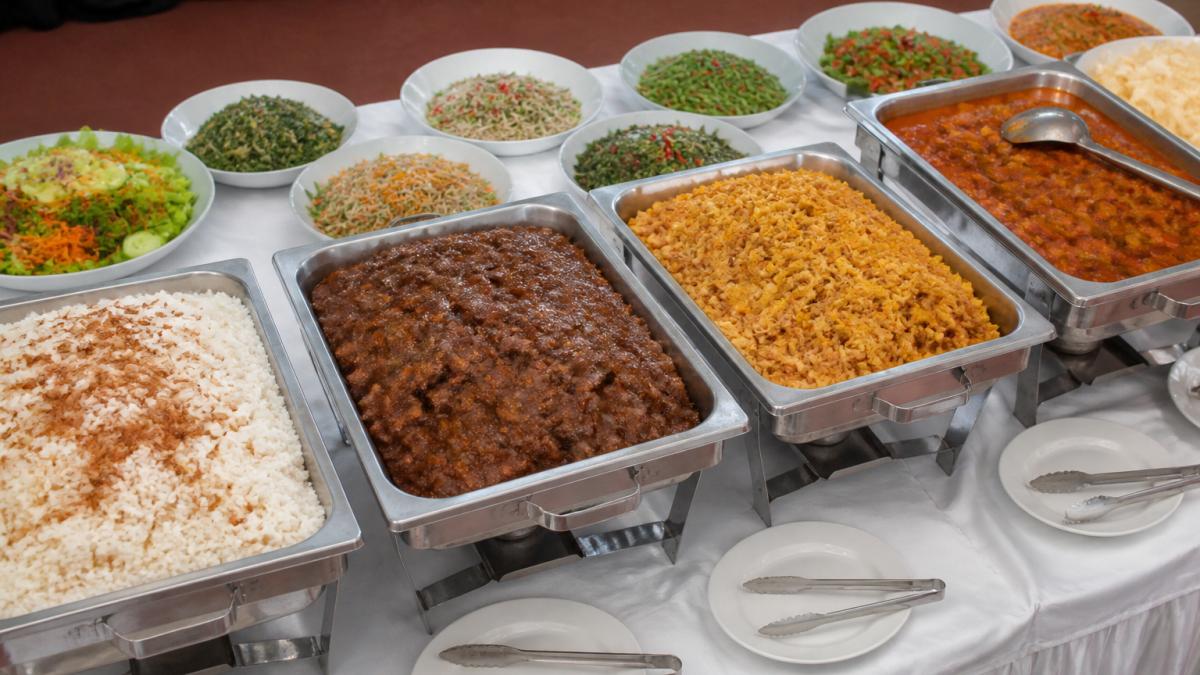
Wedding Reception Example
You're catering a wedding reception for 95 confirmed guests. The event runs from 6 PM to 11 PM (5 hours).
Cocktail hour (first 2 hours): 95 guests × 5 pieces per person = 475 pieces of appetisers needed.
Buffet dinner (remaining 3 hours): 95 guests × 1.5 servings per person = 142 servings of main course.
For a wedding, guests typically eat less of the appetisers because they're anticipating the main meal. This is why we use 1.5 servings rather than 2.5, people are more selective.
Adjusted total: 475 appetiser pieces + 142 main course servings. Add sides (rice, vegetables, salads) at 1.5 cups per person = 142 cups of sides.
Build in 10% extra for this guest count: add 48 extra appetiser pieces and 14 extra main servings.
Final quantities: 523 appetiser pieces, 156 main servings, 156 cups of sides.
Corporate Lunch Example
You're catering a corporate lunch for 80 people. The event runs from 12 PM to 1:30 PM (1.5 hours). It's a buffet lunch with no drinks reception beforehand.
Buffet lunch: 80 guests × 2.5 servings per person = 200 servings of main course.
For a corporate lunch, people eat more because it's their only meal break. They're not grazing, they're eating a proper lunch. This is why we use 2.5 servings.
Sides: 80 guests × 1.5 cups per person = 120 cups of sides (rice, salads, vegetables).
Dessert: 80 guests × 1 serving per person = 80 servings (assuming not everyone eats dessert, we plan for full coverage but expect 60-70% uptake).
Build in 5% buffer for this size: add 10 main servings and 6 cups of sides.
Final quantities: 210 main servings, 126 cups of sides, 80 dessert servings.
Buffet Portion Sizes Per Person: Adjusting for Service Style
How you serve your food changes how much people eat. A buffet where guests serve themselves typically results in larger portions per person than a plated sit-down meal.
Buffet service: Guests serve themselves and eat standing or sitting. They typically take larger portions. Plan for 2.5-3.5 servings per person for a meal.
Plated service: You or your caterer portions each plate. You control portion size. Plan for 1.5-2 servings per person.
Passed appetisers: Guests take pieces as they pass. They eat more casually. Plan for 5-8 pieces per person for a 2-hour event, fewer if a meal follows.
Family-style service: Large platters go on the table and guests pass them. People take moderate portions. Plan for 2-3 servings per person.
Ninin's Indo Street Food offers flexible service options, from a food trailer setup for casual events to full buffet service for formal occasions.
Using a Catering Food Calculator to Estimate Quantities
Many caterers provide online tools to help you estimate portions. A catering food calculator takes your guest count, event type, and menu choices and generates a quantity estimate.
How to use one:
Input your guest count. Enter the event type (cocktail, lunch, dinner, afternoon tea). Select your menu items. The calculator multiplies these against standard serving sizes and shows you total quantities.
These tools are useful starting points, but they're not perfect. They use average serving sizes, which don't account for your specific guest mix. If your event has many vegetarians, you'll need different quantities than an event with mostly meat eaters. If your guests include athletes or manual workers, they'll eat more than office workers.
Use a calculator as a baseline, then adjust based on your actual guest profile and menu composition.
How to Calculate Food Cost Per Portion and Stay on Budget
Once you know your quantities, you can calculate your cost per portion, and make sure you stay within budget.
The formula is:
Cost Per Portion = Total Food Cost ÷ Total Servings
Let's say you're catering for 100 people. Your total food cost is $1,200. Your cost per portion is $1,200 ÷ 100 = $12 per person.
Work backwards from your budget. If you have $1,500 to spend on catering for 100 people, your target cost per portion is $15. This helps you decide which menu items to include.
Expensive proteins (premium seafood, wagyu beef) cost more per portion. Budget-friendly options (chicken, legumes, rice-based dishes) cost less. Mix them strategically to hit your target.
Ninin's Indo Street Food works with clients to build customised packages within their budget. Authentic Indonesian cuisine often delivers excellent value because traditional dishes are built on slow-cooked proteins and rice or noodle bases, naturally cost-effective while tasting rich and satisfying.
Adjusting Quantities for Dietary Needs and Menu Composition
Your guest list likely includes people with different dietary requirements. Vegetarians, vegans, gluten-free guests, dairy-free guests, and others need menu options that work for them.
Count your dietary groups. Ask guests about restrictions when you send invitations. Get a rough percentage: "How many guests are vegetarian?
Adjust your quantities accordingly. If 20% of your guests are vegetarian, allocate 20% of your main course servings to a vegetarian protein.
Don't assume people will share. A vegetarian guest shouldn't have to eat side dishes only because the main course is meat. They deserve a proper main course option.
Plan for overlap. Some guests are both vegetarian and gluten-free. Others are dairy-free and vegan. Build flexibility into your menu so one dish can serve multiple dietary needs.
Indonesian cuisine naturally accommodates many dietary requirements. Vegetable-based dishes, seafood options, and rice or noodle bases work well for various restrictions.
Planning for Leftovers, Waste, and Shortage Prevention
Food waste is real. Some guests eat more, others eat less. Some dishes are more popular than others.
The general rule: Expect 10-15% of food to go uneaten at most events. This accounts for:
- Guests who eat less than average
- Dishes that are less popular
- Food that spoils or gets damaged during service
- Natural variation in appetite
Build this into your order. If you calculate you need 200 servings, order 220-230 to cover waste and ensure you don't run short.
But don't over-order massively. Ordering double the amount you need to avoid any shortage is wasteful and expensive. The 10-15% buffer is usually sufficient.
Plan for leftovers strategically. Some events expect leftovers (casual office lunches, family gatherings). Others don't (formal weddings, client entertainment). Discuss this with your caterer upfront.
Consider food safety. Leftover food needs proper storage and handling. If your event is outdoors or runs for many hours, food spoilage is a real concern.
Ninin's Indo Street Food can advise on realistic quantities for your specific event.
Getting your catering portions right transforms your event from stressful to smooth. You feed your guests properly, stay within budget, and avoid waste.
Frequently Asked Questions
How much food do I need for 100 guests at a catered event?
For a sit-down meal, allow 200-250 grams of prepared food per person (including protein, vegetables, and carbohydrates). For a buffet, increase to 250-300 grams per person. For a cocktail party with appetisers only, plan 8-12 pieces per person. The exact amount depends on meal period, event duration, and whether alcohol is served. A worked example: 100 guests at a lunch buffet would need roughly 25-30 kilograms of prepared food total.
What's the difference between portion sizes for buffet versus plated service?
Buffet service typically requires 20-30% more food than plated service because guests serve themselves and often take larger portions. For buffet, plan 250-300 grams per person; for plated meals, 200-250 grams is usually sufficient. Buffet also allows flexibility, guests can skip items they don't like, so offering variety reduces waste. Plated service gives the caterer more control over portion consistency.
How do I use a catering food calculator to estimate quantities accurately?
A catering food calculator requires four inputs: guest count, meal type (breakfast, lunch, dinner, cocktail), event duration, and whether service is plated or buffet. The calculator multiplies guest count by a standard serving size for that meal type, then adjusts for duration and service style. Most calculators also account for dietary variations. Input your details, and the tool returns total grams or kilograms needed for each dish category. Always add 10-15% extra for contingency.
How do I calculate the cost per portion for my catering budget?
Divide your total catering budget by the number of guests to find cost per person. For example, a $2,000 budget for 80 guests = $25 per person. Then work backwards: if you know the cost per portion, multiply by guest count to find total spend. When comparing caterers, always ask whether the quoted price includes service charges, delivery, and staffing. Ninin's Indo Street Food provides custom quotes based on your guest count, menu selections, and delivery requirements, contact them for a detailed estimate tailored to your event.