Table of Contents
- Asian Aussie vs Hut and Soul: Quick Comparison
- What Sets Each Restaurant Apart
- Asian catering for weddings: Which Restaurant Delivers?
- Asian catering for corporate events: Reliability and Customisation
- The Satay Hut alternative for events: Why Authentic Indonesian Catering Stands Out
- Questions to ask a caterer before you book
- Making Your Choice
- Frequently Asked Questions
Last Updated: October 16, 2026
Asian Aussie vs Hut and Soul: Quick Comparison
Asian Aussie vs Hut and Soul is a decision many event planners face when seeking Asian cuisine in Adelaide. Both operate in the same market but differ in approach, menu philosophy, and execution.
The choice isn't just about food, it's about reliability, customisation, authenticity, and whether a caterer understands your event's needs.
What Sets Each Restaurant Apart
Most pages ranking for this query are directories that tell you a venue exists and roughly what it serves, but rarely what a meal costs or which venue suits which occasion. This section compares both on the criteria that decide a booking.
Asian Aussie: menu, atmosphere, and service
Asian Aussie is a broad pan-Asian kitchen drawing on Thai, Chinese, Vietnamese, and Malaysian influences.
On the plate. Expect satay skewers, spring rolls, fried rice and noodle stir-fries, curries, and wok and grill mains.
Service model. Asian Aussie runs primarily as a dine-in restaurant with catering alongside, so catering jobs slot into the kitchen's table-service rhythm.
Best fit. Large, mixed-preference groups; casual celebrations; corporate lunches where broad appeal beats a single culinary story.
Hut and Soul: menu, atmosphere, and service
Hut and Soul takes the opposite bet: a narrower menu with a clearer regional identity, in a space designed to feel intentional.
Service model. Hut and Soul treats catering as a core offering, not a side stream.
Dietary handling. Fewer dishes means fewer places for an allergen to hide.
Best fit. Mid-sized weddings and corporate functions where the food is meant to carry a story; date nights and small celebrations where atmosphere matters as much as the menu.
Side-by-side: the criteria that actually decide it
| Criterion | Asian Aussie | Hut and Soul |
|---|---|---|
| Menu identity | Broad pan-Asian (Thai, Chinese, Vietnamese, Malaysian) | Focused regional menu |
| Indicative main price | AUD $18-$30 | AUD $22-$34 |
| Catering role | Alongside restaurant operations | Core part of the offering |
| Customisation style | Reactive, you ask, they accommodate | Consultative, they ask first |
| Dietary strength | Wide vegetarian/GF building blocks; cross-contact risk | Fewer allergen hiding places; narrower suitable list |
| Occasion fit | Large mixed groups, casual functions | Weddings, mid-sized corporate, date nights |
Check current aggregate ratings and recent diner reviews before booking
Asian catering for weddings: Which Restaurant Delivers?
Wedding catering demands emotional resonance. Guests remember the food, but also how it made them feel.
Hut and Soul's consultative model aligns with wedding expectations: they discuss guest count, dietary restrictions, cultural preferences, and budget before finalising the menu.
Asian Aussie can cater weddings, and its menu flexibility appeals to couples with mixed guest preferences.
For weddings, the caterer who treats events as their primary business tends to deliver better outcomes.
Asian catering for corporate events: Reliability and Customisation
Corporate catering is judged on a different scorecard. Nobody remembers the centrepiece; everybody remembers if lunch arrived late, if half the room couldn't eat, or if the invoice exceeded the quote.
What 'reliability' actually means in practice
Reliability is a set of checkable mechanisms. For any corporate booking, ask how each of the following is handled:
- Production scheduling. If the caterer also runs a restaurant, ask how catering orders are sequenced against dine-in service on the same day. A kitchen that produces catering before service opens behaves very differently to one that produces it between covers.
- Holding and transport. Hot food must be held above the temperature danger zone during transport and service (Food temperature and thermometers). Ask what equipment is used, insulated carriers, hot boxes, chafing dishes, or bain-maries, and whether staff monitor temperatures on site.
- Portion consistency. For a 100-person order, ask how portions are standardised. A caterer who can describe their per-head gram or piece counts has solved this; one who says 'we just make enough' has not.
- On-site staffing. Clarify whether the quote includes serving staff, who sets up and clears, and who is the single point of contact on the day if something goes wrong.
- Contingency. Ask what happens if guest numbers change within 72 hours, if a dish is unavailable, or if a staff member calls in sick. A caterer with systems will have an answer ready.
Dietary coverage: the part most corporate bookings get wrong
Corporate events concentrate dietary requirements. In an office of 100, expect a meaningful minority with at least one of: vegetarian or vegan diets, gluten intolerance or coeliac disease, dairy avoidance, nut or shellfish allergies, or religious restrictions such as halal or no pork.
What to demand from either venue:
- A written allergen matrix for the proposed menu, listing which dishes contain the major allergens (gluten, shellfish, fish, soy, egg, dairy, peanuts, tree nuts, sesame).
- Clear on-site labelling for every dish, not a verbal briefing to one staff member.
- A named vegetarian and vegan option that is a genuine dish, not a plate of steamed vegetables.
- Confirmation of whether halal or no-pork options are available, and whether the kitchen can guarantee no cross-contact.
A focused regional menu (Hut and Soul) is easier to allergen-map because there are fewer dishes. A broad pan-Asian menu (Asian Aussie) offers more vegetarian building blocks but more places for hidden fish sauce, shrimp paste, or wheat-based sauces.
Accessibility and family needs
Corporate events increasingly include guests with mobility needs, parents with young children, and attendees who need clear signage. Ask:
- Can the buffet or service point be reached without stairs, and is there space for a wheelchair or pram to manoeuvre?
- Are there seated options for guests who cannot stand through a buffet queue?
- Are high chairs or a child-friendly dish available if families are attending?
- Is the menu printed in a readable size with allergen icons, or only available verbally?
Value for money: how to compare quotes properly
Two quotes at the same headline per-head price are rarely equivalent. Compare total delivered cost:
| Line item | Why it matters |
|---|---|
| Per-head food cost | The headline figure, but rarely the whole story |
| Serving staff | Often excluded; can add significantly per hour |
| Equipment hire | Chafing dishes, urns, plates, cutlery, linen |
| Delivery and setup | Distance-based; confirm whether included |
| Cleanup | Some caterers leave everything; others charge to clear |
| Dietary surcharges | Per-head uplift for vegan, GF, or halal options |
| Weekend or after-hours loading | Common for Friday evening and weekend corporate events |
| Cancellation terms | What you lose if the event is postponed |
Ask every caterer to quote on the same brief, same headcount, service style, dietary mix, and location, so the comparison is like-for-like.
Which venue for which corporate scenario
- Large all-hands or town hall (100+ guests, mixed preferences): Asian Aussie's broad menu reduces the risk of anyone going hungry, and its restaurant-scale kitchen has experience with high-volume service. Confirm the catering-versus-service scheduling question before booking.
- Client dinner, team offsite, or culture-building lunch (20-60 guests): Hut and Soul's consultative model suits events where the food is meant to reinforce a message. Expect a longer planning lead time and a slightly higher per-head cost.
- Recurring office lunches: Ask both venues about a standing menu and a fixed per-head rate. Predictability usually beats novelty for repeat corporate orders.
Check current food safety and allergen labelling guidance for catered events
The Satay Hut alternative for events: Why Authentic Indonesian Catering Stands Out
Beyond Asian Aussie and Hut and Soul, authentic Indonesian catering is a distinct category worth considering.
An Indonesian specialist has mastered a specific tradition, layering spices, slow-cooked proteins, and the balance of richness and brightness.
For weddings and corporate events, Indonesian catering works well when guests know the cuisine or you want something genuinely different.
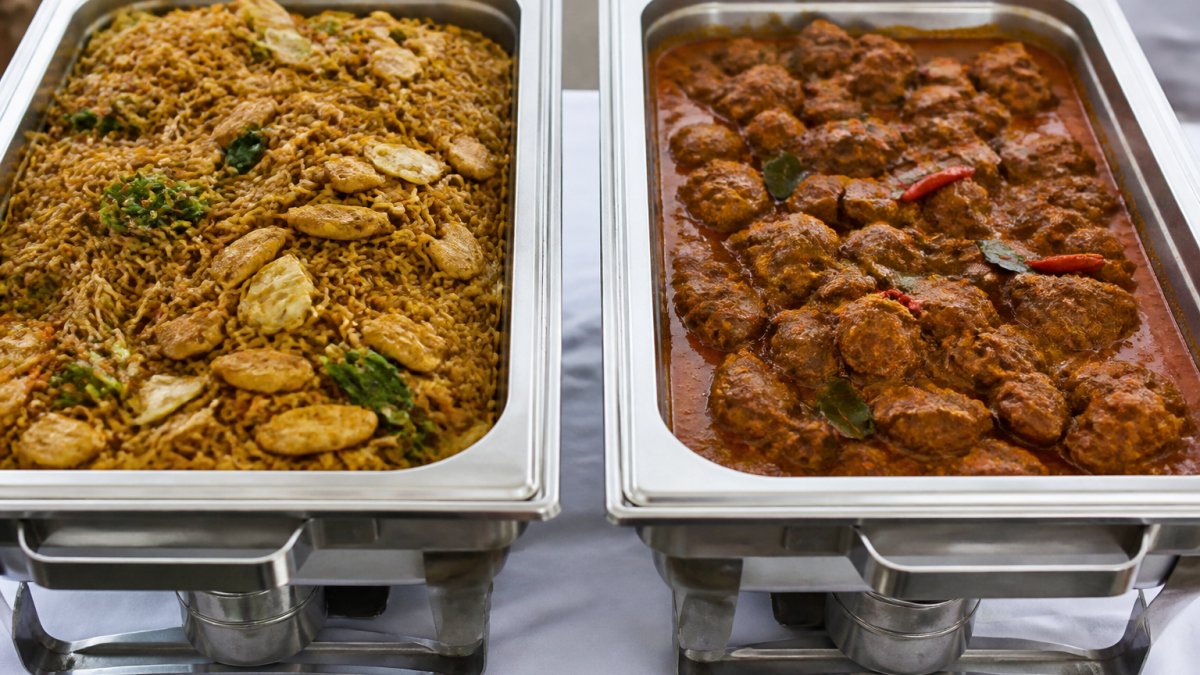
Ninin's Indo Street Food exemplifies this.
Questions to ask a caterer before you book
Before committing to any catering partner, ask these questions to reduce surprises:
Menu and customisation: Can they accommodate vegan, gluten-free, dairy-free, or nut-allergy requirements? Do they offer a tasting before committing? How flexible are they on modifying dishes or substituting proteins?
Portion sizes: How many guests can they reliably serve? What's their typical serving size, and can you see examples from previous events?
Timing and logistics: When do they arrive, and how long does setup take? Do they stay for the event or just deliver?
Pricing and inclusions: Does the base price cover food only, or also serving staff, plates, cutlery, and cleanup?
These questions separate caterers with systems from those who improvise.
Making Your Choice
Choosing between Asian Aussie, Hut and Soul, and specialists like Ninin's Indo Street Food comes down to what matters most for your event.
Choose Asian Aussie if: You need broad menu appeal for a large, diverse group, value walk-in restaurant credibility, or want a caterer who adapts quickly to mixed dietary preferences.
The best choice isn't about which caterer is objectively "best", it's about which approach aligns with your event's priorities and your guests' preferences.
Frequently Asked Questions
What is the difference between Asian Aussie and Hut and Soul for catering?
Asian Aussie focuses on broad Southeast Asian cuisine with a casual dining model, while Hut and Soul emphasises regional specialisation and intimate dining experience. For catering, the key difference lies in menu flexibility, portion sizing, and how each handles customisation for events. Asian Aussie typically offers set menus suited to larger groups, whereas Hut and Soul provides more bespoke options. Your choice depends on whether you want variety across cuisines or depth in one regional style, and how much customisation matters for your event.
What questions should I ask an Asian caterer before booking for my wedding or corporate event?
Ask about portion sizes and how they guarantee adequate servings for your guest count. Confirm their experience with your specific event type (wedding, corporate, community). Request details on dietary accommodation including gluten-free, dairy-free, and vegan options. Clarify delivery times, setup and breakdown services, and what happens if they're running late. Ask for recent references from similar events and whether they offer tastings. Confirm pricing structure, payment terms, and cancellation policies. Get everything in writing, including the final headcount deadline and any additional fees.
Is buffet or food-trailer catering better for an event?
Buffet catering works best for indoor events with controlled space and guest flow, offering guests variety and flexibility. Food-trailer catering suits outdoor festivals, street events, and venues where guests move between locations. Buffet requires proper serving stations and temperature control; trailers are mobile and create an experiential element. For weddings, buffet typically feels more formal; trailers suit casual gatherings and community events. Consider your venue layout, weather, guest count, and the atmosphere you want to create. Many caterers offer both options, so discuss which suits your specific event needs.
How do I know if a caterer's portions are genuinely generous?
Request specific serving weights or portion descriptions in writing before booking. Ask the caterer for recent photos from similar events showing plated food and table setups. Contact past clients directly and ask whether guests felt satisfied with portion sizes. A reputable caterer should be transparent about their portion philosophy and willing to discuss it in detail. If they're vague or defensive about serving sizes, that's a red flag. For peace of mind, request a tasting with realistic portion sizes before committing to your full event.
Planning an event where authenticity, reliability, and generous portions matter? Ninin's Indo Street Food brings 19 years of Javanese catering expertise to weddings, corporate functions, and community gatherings across Adelaide. Our family-run team customises every menu around your event type and budget, with flexible options including food trailer service and full buffet setups. Get an instant quote and experience the difference specialisation makes.