
Last Updated: November 14, 2026
Quick Summary
Start by setting a fixed total budget, then divide it by your guest count to get a working cost per person, adding about 10 per cent for extra guests. Compare quotes only after itemising food, service, delivery, equipment and taxes, because a low per-head price can rise once extras are included. A clear event catering budget keeps decisions grounded in numbers rather than menu wishes.
- Set your total spend first, then guest count, then event type.
- Divide the food budget by guests and add a buffer of around 10 per cent.
- Check whether quotes include staff, delivery, crockery and setup.
- Confirm whether quoted prices include GST, which adds 10 per cent at invoice.
- Hold back about 10 per cent of the total as a contingency row.
Table of Contents
- Setting a Realistic Event Catering Budget
- How to Calculate Catering Costs Per Person
- Event Catering Budget Template and Itemised Cost Worksheet
- Cheap Catering Menu Ideas for a Party
- Planning Food Quantities and Dietary Requirements Without Blowing the Budget
- Questions to Ask a Caterer Before Booking
- Booking Your Event Catering With Ninin's Indo Street Food
- Frequently Asked Questions
Setting a Realistic Event Catering Budget
Planning event catering on a budget starts with a clear number, not a menu. Catering usually sits in a cost structure where food takes 60-70% of the total catering spend and service takes 15-25%, according to Kelli's Catering Planning Guide 2025. , so use them as a starting frame and check the figures against your own quotes.
Families and community groups often find that the budget that works is the one set before anyone chooses dishes. Write down the total you can spend, then the number of guests, then the event type. Those three figures decide almost everything else.
Defining Event Priorities and Allocating Spend
Decide what matters most before you spend. A wedding reception may put food quality and generous portions first, while a staff lunch may prioritise convenience and dietary coverage. Rank your priorities, then give the largest share of the budget to the top one. Once those priorities are clear, create a wedding budget that gives food and service the right share alongside the rest of the celebration.
Keep the list short. Three priorities are usually enough: for example, food that guests enjoy, enough portions, and a service format that suits the venue. Anything outside that list gets trimmed first.
How to Calculate Catering Costs Per Person
Divide your total food budget by the number of guests to get a working cost per person. Then add a buffer of around 10 per cent for last-minute guests and small over-orders. For a step-by-step method to work out exact portion quantities for any event, see how to calculate catering portions. This gives you a realistic figure to compare against quotes.
Per-person pricing is only useful if you compare like with like. Check whether a quote includes staff, delivery, crockery, and setup. A low per-head price can rise sharply once those extras are added.
Event Catering Budget Template and Itemised Cost Worksheet
A worksheet is only useful if it forces every cost into the open before you compare quotes. Build it in a spreadsheet with one column per caterer and these rows down the left side: guest count, food cost per head, service and staffing, delivery, equipment hire, crockery and serveware, linen, cleanup, taxes, and contingency. Fill in your own estimate for each row first, then enter each quote beside it. The caterer whose total is closest to your estimate is not automatically the best value, the one whose line items are most complete usually is.
Work through the rows in this order:
- Guest count, the confirmed number, plus a separate row for the 5-10 per cent of guests who may arrive without replying.
- Food cost per head, the caterer's quoted food figure only, stripped of service and delivery so it can be compared directly.
- Service and staffing, ask whether this is a flat fee or an hourly rate, and whether overtime applies after a set number of hours.
- Delivery, confirm whether it covers a return trip, stairs, or a set-up window, and whether a delivery surcharge applies outside business hours.
- Equipment hire, chafing dishes, urns, serving utensils, and any furniture the caterer supplies rather than the venue.
- Crockery and serveware, disposable versus hired plates, cutlery, and glassware; hired items usually carry a breakage charge.
- Linen and presentation, tablecloths, napkins, and any styling the caterer includes or charges for.
- Cleanup, whether the caterer clears and removes rubbish or leaves it to you or the venue.
- Taxes, confirm whether quoted prices include GST, because a quote that excludes it will rise by 10 per cent at invoice.
- Contingency, hold back about 10 per cent of the total as a separate row you do not spend unless you must.
Watch out: a quote that looks cheapest per head can be the most expensive once delivery, staffing minimums, and GST are added, so never compare headline per-person figures without the full worksheet beside them.
Keep the worksheet live. When a caterer changes a figure or waives a fee, update the row and re-total rather than relying on memory. At the end you will have a like-for-like comparison and a record of what each price actually includes, which is the single most useful document you can take into a negotiation.
The worksheet rows below summarise the cost items to itemise before comparing quotes.
| Worksheet row | What to check | Watch for |
|---|---|---|
| Guest count | Confirmed number plus a buffer row | 5-10 per cent unconfirmed guests |
| Food cost per head | Food figure only, stripped of extras | Compare like with like |
| Service and staffing | Flat fee or hourly rate | Overtime after set hours |
| Delivery | Return trip and set-up window | Out-of-hours surcharge |
| Taxes | Whether quote includes GST | Rises 10 per cent at invoice |
| Contingency | About 10 per cent held back | Spend only if needed |
Cheap Catering Menu Ideas for a Party
Budget menus work best when they combine filling dishes with a few higher-impact items. Rice-based dishes, slow-cooked meats, and vegetable sides stretch well across a crowd, and they keep costs predictable.
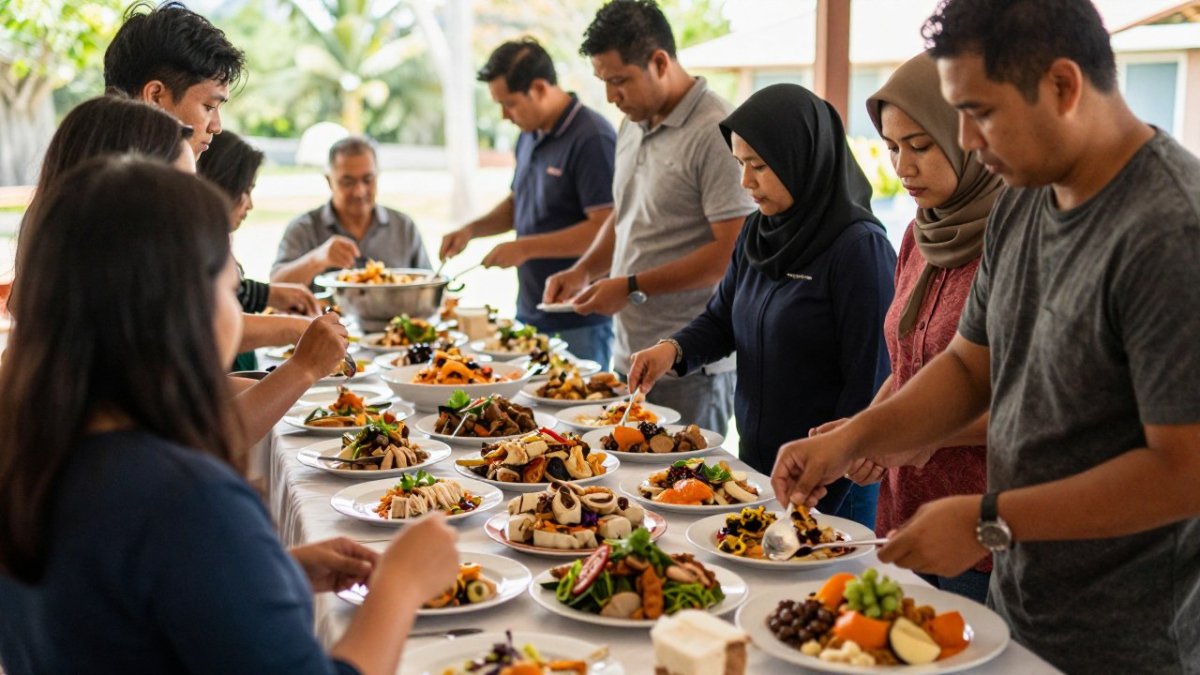
Choose dishes that can be served in bulk and hold their quality on a buffet table. Two or three mains with a couple of sides usually feed a group more reliably than a long list of small plates.
Buffet, Platter and Self-Service Formats
Buffets and shared platters are often the most economical service style because they reduce staffing and plating time. Guests serve themselves, and the caterer prepares fewer individual portions.
The trade-off is that buffets need a clear layout and enough trays to keep the line moving. For a small group, a platter arrangement can deliver the same value with less setup.
Planning Food Quantities and Dietary Requirements Without Blowing the Budget
Quantity planning is where budgets are won or lost. Over-order and you pay for food that is thrown away; under-order and guests notice. Start with the meal type and the event duration, because both change how much people eat.
As a working guide, most caterers plan on the following per-guest basis:
- Canapés or finger food only (1-2 hours): 4-6 pieces per guest if the event is short, rising to 8-10 pieces if it runs longer or replaces a meal.
- Buffet main meal: one generous serving of each main per guest, plus roughly 10 per cent extra to cover second helpings.
- Starch and sides: plan rice, bread, or potatoes at about 150-200 g per guest cooked weight, and vegetables at about 100-150 g.
- Dessert: one portion per guest, with a small buffer if dessert is the highlight.
- Children: count them at roughly half an adult portion unless the caterer advises otherwise.
These are starting estimates, not rules. A lunchtime event, an older guest profile, or a very hot day usually means people eat less; an evening event with alcohol, or a crowd that has travelled, usually means they eat more. Ask the caterer to confirm quantities against your specific event rather than accepting a generic per-head figure.
Dietary requirements do not have to mean a separate, expensive menu. Gather requirements at the same time as RSVPs using a short question that captures vegetarian, vegan, gluten-free, dairy-free, nut allergy, and any other needs, and count them before you choose dishes.
Label every dish on the buffet with its name and its dietary status, and keep serving utensils separate for allergen-free dishes to reduce cross-contamination. Ask any caterer you are considering how they handle a serious allergy, including whether dishes are prepared in a separate area.
Questions to Ask a Caterer Before Booking
Ask every caterer for a written quote that breaks down food, service, delivery, and equipment. Before you approach a provider, check what minimum order sizes small event caterers require. Confirm the minimum order size, since small groups often face minimums that change the economics.
Also ask about timing, arrival windows, and what happens if guest numbers change. Clear answers to these questions protect your budget and make the event run more smoothly.
Booking Your Event Catering With Ninin's Indo Street Food
Ninin's Indo Street Food serves weddings, corporate functions, and community events across Adelaide, with buffet service and a food trailer option. Pricing depends on quantity, date, and delivery, so the most reliable way to compare is to request a tailored quote for your event and share your guest count and budget.
If you are planning a larger function, get in touch with the team to talk through your event. We will help you match your budget to the menu and portions that suit your guests.
Frequently Asked Questions
How do you set a budget for event catering?
Start with the total amount you can spend, then deduct fixed costs such as venue hire, equipment and staffing. What remains is your food budget. Divide it by the number of guests to get a working cost per person, and check that figure against the guest count you expect to confirm, not the number invited. Keep a contingency of around 10 per cent for last-minute guests or extra servings. Ask caterers for quotes that show per-person pricing so you can compare offers on the same basis.
How much food should you order per guest?
Portion needs depend on the event length, time of day and whether food is the main activity. For a light event of around two hours, plan roughly three to four bites or small serves per guest per item across a few options. For a meal-style event, plan a full main-sized serve per person and add a side or dessert option. When in doubt, ask your caterer for portion guidance based on your guest numbers, since generous portions reduce the risk of guests going hungry without over-ordering.
Is buffet catering cheaper than plated service?
Buffet and shared-platter service is usually cheaper than plated service because it needs fewer staff to serve, less crockery handling and simpler timing. It also lets you control quantities more easily. Plated service suits formal events where table service is part of the experience. For budget events, a buffet or food trailer format with self-service keeps staffing costs lower while still giving guests generous, freshly cooked food.
What should an event catering quote include?
A clear quote should list the menu items and quantities, the price per person, delivery and set-up fees, staffing charges, equipment such as serving dishes or a food trailer, and any service or cancellation terms. Check whether dietary options are priced separately and whether GST is included. Comparing quotes on the same guest count and menu scope gives you a fair picture of cost, and avoids surprises on the invoice.
How do dietary requirements affect a catering budget?
Dietary needs such as gluten-free, dairy-free or vegan requests can raise costs if they require separate menus or cooking equipment. You can keep costs down by choosing dishes that are naturally adaptable, such as rice-based or vegetable-forward dishes, and by labelling options clearly so guests can choose for themselves. Ask caterers how they prevent cross-contamination and whether they can cover multiple requirements within one menu rather than charging for each separately.
How far in advance should you book event catering?
Book as early as you can, particularly for weekends, peak seasons and festival dates, when caterers may already be committed. Many caterers can accept smaller events at shorter notice, but confirming your date, guest numbers and menu early gives you the best choice of options and avoids rushed decisions that can increase costs.
What are the most affordable foods to serve at an event?
Filling, shared dishes tend to offer the best value. Rice dishes, noodles, pasta, pizza, wraps and vegetable-based dishes stretch further than premium proteins. Platters of finger food work well for mixed crowds, and one or two protein dishes combined with plenty of sides usually feel generous without being expensive. Choosing a small number of well-made dishes also reduces food waste compared with offering a long menu.
