
Quick Summary
The best Asian catering for a large event is a team that can feed your full guest count on time, with generous portions and dietary needs covered. Compare written quotes that itemise food, service and setup, since a lower total often means fewer dishes or no staff. Match the service style to the event, whether a buffet, platters or a food trailer.
- Ask how many dishes are included per guest and whether rice and sides are counted.
- Compare written quotes that list each item, because lower totals often mean fewer dishes or no staff.
- Collect dietary requirements early and confirm allergen handling and labelling in writing.
- Plan portions from your guest count and add a small buffer for seconds.
- Book early, sharing your date, guest count, dietary needs and budget for a tailored quote.
Table of Contents
- Asian Catering for Large Events: What to Look For
- Asian Catering Menu Ideas for Weddings, Corporate Functions and Community Events
- Asian Buffet Catering: Planning Portions for a Large Guest Count
- Food Trailer Catering for Events: How It Works on the Day
- Dietary Needs, Allergens and Cross-Contamination at Large Events
- Budget Planning for Asian Catering on a Tight Budget
- Comparing Asian Caterers: The Satay Hut Alternative for Events
- Booking Your Indonesian Catering With Ninin's Indo Street Food
- Frequently Asked Questions
Asian Catering for Large Events: What to Look For
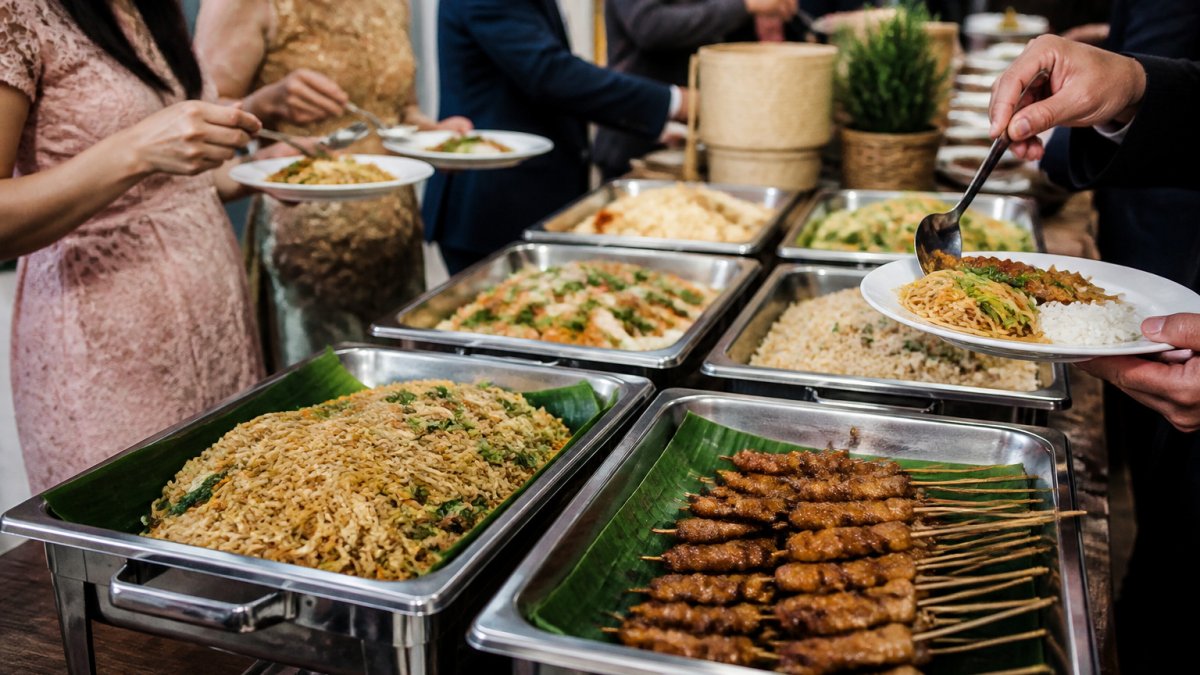
Choosing Asian catering for a large event is less about the cheapest quote and more about finding a team that can feed a big crowd well, on time, with dietary needs covered. If you want to see the Indonesian buffet offering and how to order it, you can explore our Indonesian buffet catering.
Asian catering covers many styles, from buffets and platters to food trailers serving dishes to order. A seated wedding for 80 guests needs a different setup from a staff lunch or a community festival stall.
Start with three questions. Can the caterer handle your guest count without stretching the kitchen? Do they have a clear process for service and setup? Will they talk openly about pricing and dietary requirements before you book?
Ask how many dishes are included per guest and whether sides and rice are counted in the quote.
Pricing depends on guest numbers, event date, delivery distance and menu choice, so no single figure applies. Ask for a written quote that lists each item and what it covers.
Watch out: Do not compare quotes that include different portion sizes or service staff. A lower total often means fewer dishes, no setup, or no staff on the day.
Asian Catering Menu Ideas for Weddings, Corporate Functions and Community Events
The right menu depends on who is eating and how. Shareable platters suit many corporate lunches and community events, where guests move around and graze. Buffets suit many weddings, where a seated group serves themselves at their own pace.
For a wedding, a buffet with several mains, rice, noodles and vegetable sides gives guests choice without slowing service.
Corporate functions often need lighter, quicker options people can eat at a desk or standing up. Platters of satay skewers, spring rolls and rice dishes are practical and tidy.
Community events, from school fundraisers to club dinners, value generous portions and a menu that suits a mixed crowd, including children and older guests. Two or three mains and a couple of sides usually works best.
Asian Buffet Catering: Planning Portions for a Large Guest Count
Portion planning is where large events most often go wrong. Work out your total from your guest count first, then adjust for the mix of dishes and how hungry guests are likely to be.
Set a base quantity per guest for each main, then add rice or noodles as the filler.
Ask your caterer how they calculate servings. A step-by-step method for calculating catering portions walks through estimating quantities for your guest count.
Plan for a small buffer. It is far easier to have a little extra than to run out halfway through the line, especially when guests come back for seconds.
Food Trailer Catering for Events: How It Works on the Day
A food trailer brings a different energy to an event.
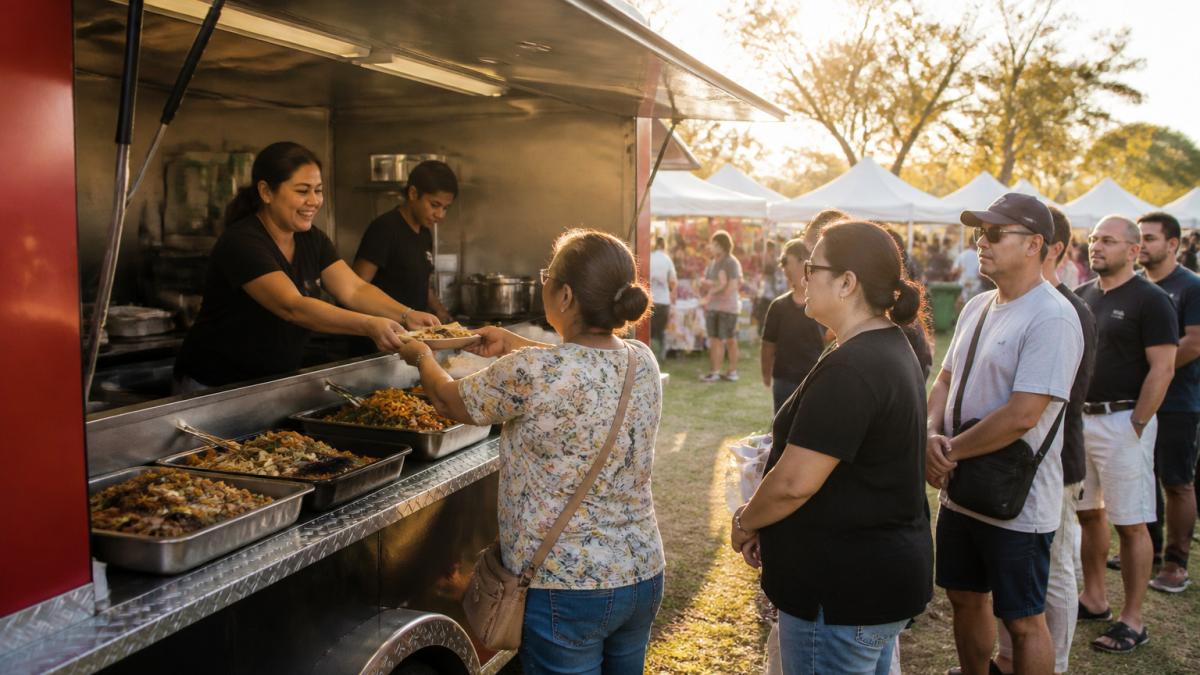
On the day, the trailer needs a level area, vehicle access, power or gas arrangements as required, and a clear spot for the queue.
Trailer service is paced by how quickly the kitchen can serve, so plan the queue with that in mind. For a large crowd, ask how many serving windows the trailer runs and how long a typical line takes.
Ninin's Indo Street Food offers a food trailer alongside its buffet service, so the trailer suits events where guests want fresh food served to order. Compare trailer and buffet options side by side to see setup, service and cost.
Dietary Needs, Allergens and Cross-Contamination at Large Events
At a large event, dietary needs stop being a courtesy and become a logistics problem.
Step 1: Collect requirements early and in writing
Ask guests to declare dietary needs at the RSVP or registration stage, not on the day.
Step 2: Map each requirement to a dish
Work with your caterer to identify which dishes are naturally suitable and which can be adapted.
Step 3: Plan separate preparation and serving
Cross-contamination at large events usually happens in three places: shared utensils, shared serving spoons and shared fryers or cooking surfaces. Ask your caterer how they handle each:
- Utensils and serving spoons. Are dedicated colour-coded utensils used for allergen-free dishes? Are serving spoons swapped between dishes or reused?
- Cooking surfaces and oil. Is gluten-free food cooked in a separate fryer or on a cleaned surface? Is shellfish cooked separately from other proteins?
- Plating and labelling. Are special-meal plates labelled with the guest's name or table, and are buffet dishes clearly labelled with their allergens?
Step 4: Label clearly at the point of service
Step 5: Handle severe allergies separately
Step 6: Confirm in writing before the event
A note on halal and cultural requirements
Halal requirements go beyond avoiding pork and alcohol, they cover how meat is sourced and prepared.
Plan dietary requirements with your caterer before the event, so the menu, labelling and separate-preparation plan are agreed in advance rather than improvised on the day.
The steps below set out how to handle dietary requirements at a large event, with a time or frequency for each.
| Step | What to do | Timing |
|---|---|---|
| Collect requirements | Ask guests to declare needs with a tick-box form and free-text field | At RSVP or registration |
| Map dishes | Build a written matrix of which dishes suit each dietary category | Before booking with the caterer |
| Plan separate preparation | Confirm utensils, fryers and surfaces are kept separate | Agreed in advance |
| Label at service | Show dish name and key allergens at standing height | At point of service |
| Handle severe allergies | Serve a separately prepared, labelled meal directly to the guest | On the day |
| Confirm in writing | Get the matrix, preparation plan and labelling approach confirmed | Before the event |
Budget Planning for Asian Catering on a Tight Budget
Most catering quotes for large events are built from the same handful of cost lines, and knowing them lets you plan a realistic budget before you approach anyone.
The cost lines that drive every quote
- Per-person food cost. This is the headline figure and usually varies by menu tier, a two-main rice-and-noodle buffet sits at a lower per-head rate than a multi-protein spread with seafood or premium cuts. Ask what the per-person rate includes: is rice counted, are sides counted, are serving utensils and chafing dishes included?
- Minimum order value. Many caterers set a minimum spend or minimum guest count for delivery and setup. A small club dinner of 30 may fall below the minimum and attract a surcharge, while a 150-guest wedding clears it easily. Confirm the minimum before you set your guest list.
- Delivery and distance. Delivery is often quoted separately and can scale with distance from the kitchen, access difficulty (stairs, loading docks, remote venues) and whether the drop-off is inside or outside normal hours.
- Staffing and service. Buffet setup, serving staff, carving stations and clearing are usually add-ons. A drop-off buffet where you serve yourself is the cheapest service style; full staffed service with waiters and cleanup is the most expensive. The gap between the two can be substantial per guest.
- Equipment hire. Chafing dishes, warming trays, platters, linen and cutlery may be included or hired separately. Ask whether hire is per item or a flat package, and who is responsible for returning it.
- GST. Confirm whether quoted prices include GST, because a quote that looks cheaper before tax can be the more expensive option once tax is added.
Building a sample budget
Work backwards from your total budget. Subtract a contingency of roughly 10 per cent for extras and surprises, then divide what remains by your guest count to get a per-head ceiling.
For example, if a community group has a set budget and 120 guests, the per-head ceiling after contingency tells them immediately whether a staffed buffet is realistic or whether a drop-off platter service is the better fit.
Where groups overspend
- Ordering too many dishes rather than generous portions of a few, a long menu of small portions costs more and feeds no one better.
- Choosing staffed service for an event where guests are standing and grazing, when platters would do.
- Forgetting delivery, hire and GST until the final invoice.
- Booking late and losing the flexibility to negotiate on date or menu.
Where groups save without cutting quality
- Choosing a drop-off buffet with self-service and borrowing or hiring equipment locally.
- Reducing the number of mains but increasing portion sizes so guests still leave full.
- Picking dishes that hold well over a couple of hours, which reduces the need for constant restocking and extra staff.
- Booking off-peak dates or weekday slots where caterers have more capacity and may offer better rates.
Share your total budget, guest count and service preference early so the menu and service style can be planned to fit, and ask for a written breakdown before you commit.
Comparing Asian Caterers: The Satay Hut Alternative for Events
If you are comparing caterers, look beyond the headline price.
Some caterers focus on platters, others on buffets, and some on food trailers. Matching the service style to your event matters more than any single feature.
Ask each caterer the same questions: how they calculate portions, how they handle allergies, what is included in the quote, and how they handle setup and timing.
Ninin's Indo Street Food is a family-run business that has operated since 2007, offering Indonesian buffet and food trailer catering for weddings, corporate functions and community events.
Booking Your Indonesian Catering With Ninin's Indo Street Food
Booking early gives you the most choice of dates and menus, especially for weddings and large corporate functions. Share your event date, guest count, dietary needs and budget when you get in touch, and the team can prepare a tailored quote.
Contact Ninin's Indo Street Food to discuss your event and get a quote.
Once you have a quote, check the portions, dietary plan and inclusions in writing. A clear booking now prevents surprises on the day and lets you focus on enjoying the event.
Frequently Asked Questions
What Asian food is best for catering a large event?
Dishes that hold well at room temperature and suit shared service work best for large events. Fried and slow-cooked dishes such as rendang, satay skewers, fried rice and noodle dishes, and spring rolls travel well and feed a crowd. Lighter items like fresh salads or cold rolls work well alongside them. Ask your caterer which dishes they can hold safely for the length of your event and how they keep them warm or chilled.
How much food should I order for a large event?
Portion needs depend on whether the meal is a main course or grazing food, how long the event runs and how many guests are likely to eat. Your caterer should be able to advise on quantities for your guest count and menu. Pricing depends on quantity, dates and delivery, so request a quote from Ninin's Indo Street Food at nisf.com.au with your guest numbers and event details for an accurate figure.
Can a food trailer cater for a large event?
Yes. A mobile food trailer can serve large crowds at festivals, community events and outdoor functions, with cooking done on site so food is served fresh. Check that the trailer, power or gas requirements and serving space suit your venue, and confirm service timing with your caterer before you book.
