
Last Updated: November 5, 2026
Quick Summary
Catering for 80 guests typically ranges from about $2,400 for drop-off service to $9,600 or more for plated meals, depending on service style. Labour, menu complexity, ingredients, delivery access and extras such as crockery and linen all shift the total. Ask each caterer for an all-in price for 80 guests.
- Drop-off service for 80 guests is typically $2,400-$3,600 in total.
- Staffed buffet for 80 guests typically runs $3,600-$6,000.
- Plated meals for 80 guests typically start around $6,000 and can exceed $9,600.
- Divide each quote by 80 and ask what the per-person figure includes.
- Ask for staffing, delivery and equipment to be itemised, since bundled service lines are hard to compare.
Table of Contents
- What Catering for 80 Guests Typically Costs
- Catering Cost Per Person by Service Style
- Food Quantities You Need for 80 Guests
- Building a Realistic Budget for Your Event
- Using a Catering Quote Checklist Before You Book
- Reviewing Catering Contract Terms and Booking Your Caterer
- Frequently Asked Questions
Catering for 80 guests depends on the service style, the menu and the extras you add. At Ninin's Indo Street Food, we've put together this guide to help Adelaide couples, corporate planners and community organisers work out a realistic budget before they book.
What Catering for 80 Guests Typically Costs
Most caterers will not publish a fixed price for 80 guests because the total moves with service style, menu, timing and venue access. What you can do is anchor your expectations with a realistic range before you request quotes, so you can tell a fair proposal from an inflated one.
A caterer's final figure depends on a handful of factors:
- Service style: drop-off needs the least labour and equipment; plated service needs the most staff per guest, which is why it sits at the top of the range.
- Menu complexity: two or three mains with a couple of sides costs less to prepare than a long spread with multiple proteins, salads and desserts.
- Ingredient cost: beef, seafood and imported specialty ingredients push the per-person price up faster than chicken, vegetables and legumes.
- Staffing ratios: a buffet for 80 might need two or three service staff plus a supervisor; a plated three-course meal for 80 typically needs more servers so courses land together.
- Delivery distance and access: a venue with loading-dock access and a service lift is cheaper to service than a park, beach or upstairs room with no lift.
- Day and season: Saturday evenings in peak wedding season (spring and early autumn) attract higher rates than a midweek lunch in winter.
- Add-ons: crockery, cutlery, linen, chafing dishes, bar service, coffee carts and cleaning each add a line to the quote.
A useful way to sanity-check a quote is to divide the total by 80 and ask the caterer to explain what the per-person figure includes. If a quote seems unusually low, check what is excluded, such as staffing, delivery or equipment.
Watch out: quotes that bundle "service" into one line without breaking out labour hours, delivery and equipment hire are hard to compare, so ask for those items itemised before you decide.
For pricing based on your date, venue and menu, request an Indonesian buffet quote with your guest count and we will build the number around your event.
Catering Cost Per Person by Service Style
Service style is one of the biggest drivers of your per-person price, and it is the choice that most changes how an 80-guest event feels. The table below compares what each service style involves.
| Service style | Typical per-person band | Indicative total for 80 guests | What drives the price |
|---|---|---|---|
| Drop-off | $30-$45 | $2,400-$3,600 | Food, packaging, delivery; you supply serving space and any reheating |
| Buffet (staffed) | $45-$75 | $3,600-$6,000 | Food, chafing dishes, service staff, setup and pack-down |
| Plated (two or three courses) | $75-$120+ | $6,000-$9,600+ | Food, higher staff ratio, crockery, cutlery, linen, course timing |
| Food truck or trailer | $35-$65 | $2,800-$5,200 | Food, site access, power or gas, service window throughput |
The pattern most caterers follow is that labour, not food, is what separates the styles: a drop-off order is largely a kitchen and delivery job, a buffet adds service staff and equipment, and a plated meal adds the most staff hours per guest because courses must be served together.
Drop-off, buffet and plated service compared
- Drop-off: the caterer delivers food ready to serve, often in recyclable or hireable trays. You need the least staff and equipment, which usually keeps costs lowest. It suits casual gatherings, office lunches and community events where guests can serve themselves.
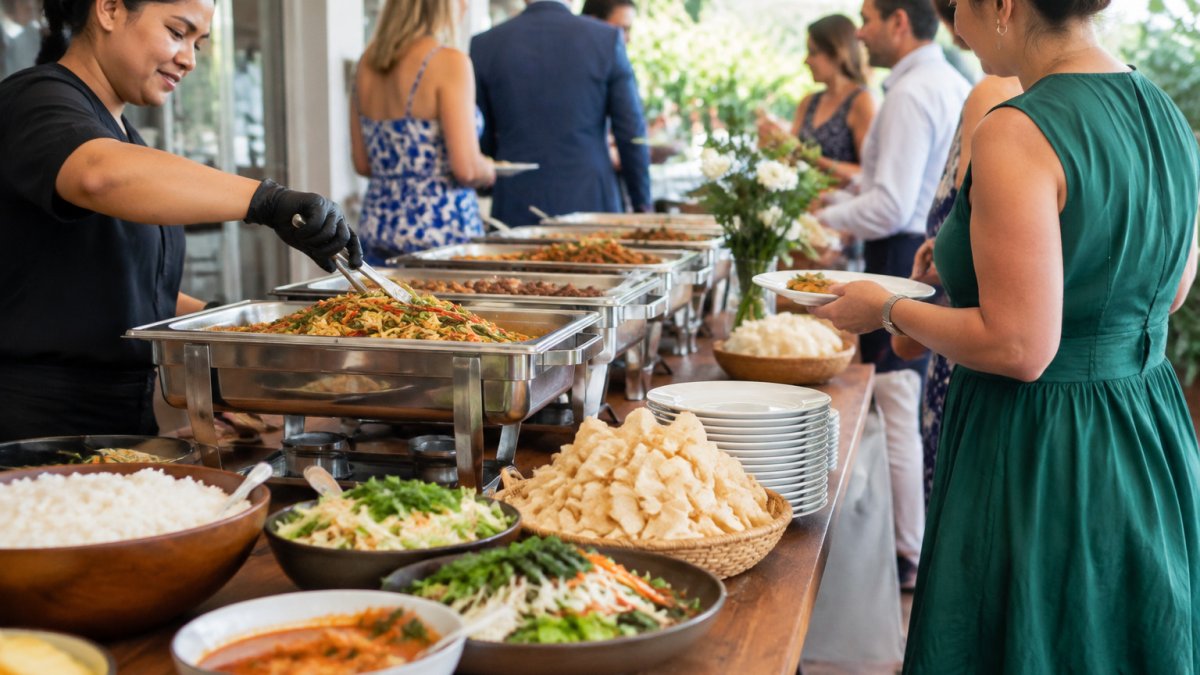
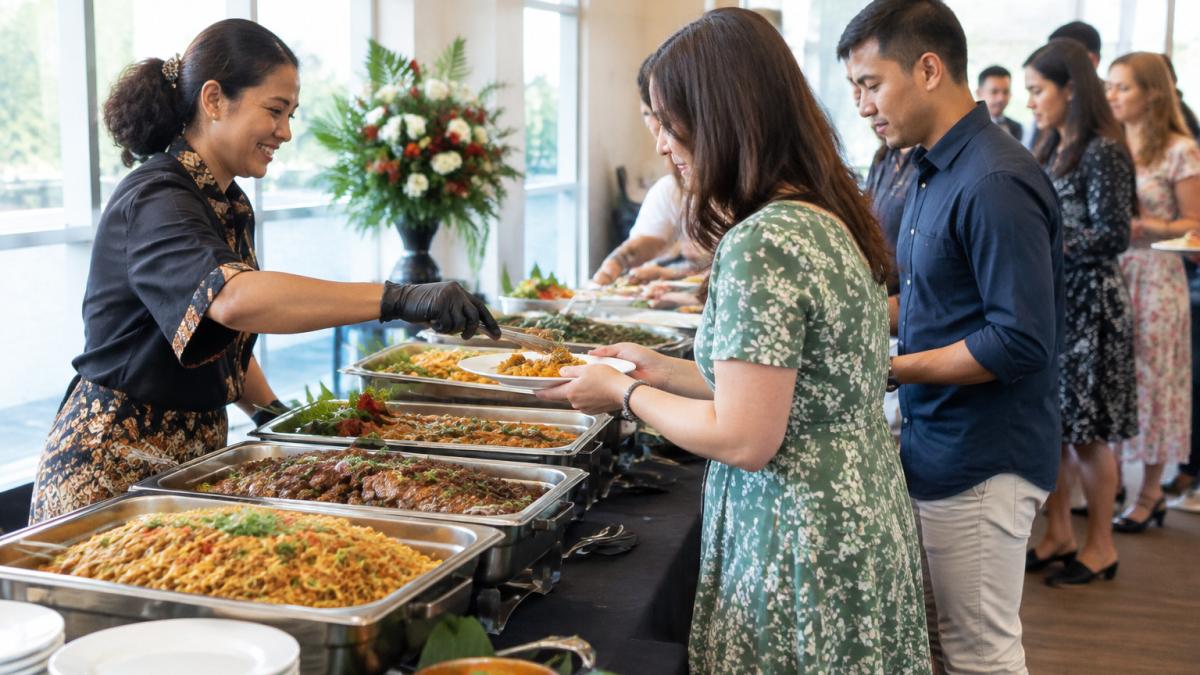
- Buffet: guests serve themselves from a set-up table. It works well for relaxed weddings and larger community events where people mingle, and it usually needs two to three service staff plus a supervisor for 80 guests to keep the line moving and replenish dishes.
- Plated: each guest receives a served meal. It is the most formal option and usually the most staff-intensive, because servers need to land each course across 80 covers at roughly the same time. Expect a higher per-person figure and a longer service window.
- Food truck or trailer: a mobile option can be cost-effective for 80 when the site has level access, power or gas, and space for a queue. Throughput matters, check how many guests the truck can serve per hour against your event length.
If you are weighing a mobile option against a buffet, our guide compares a food trailer with buffet catering for local events, covering setup, guest experience and cost.
Dietary requirements and their effect on price
Dietary needs can change your budget, mainly because they affect menu planning and preparation. Gluten-free, dairy-free and vegan dishes may require separate preparation, separate utensils and separate serving areas to avoid cross-contamination, so ask your caterer how they handle these before you book. Fully gluten-free or fully vegan menus for all guests can shift the per-person price because alternative ingredients can cost more.
For a look at Indonesian menu options that suit different needs, see our Indonesian party food catering menu ideas guide.
Building a total budget around your service style
Once you have picked a style, build the total in layers: food and service first, then drinks, then equipment and extras, then a buffer. A practical buffer is a portion of the catering total, held back for late changes such as a guest-count increase or extra staff hours.
Watch out: a per-person figure that looks low can hide a minimum spend, a delivery fee or a staffing charge that only appears at quote stage, so always ask for the all-in total for 80 before comparing styles.
Food Quantities You Need for 80 Guests
Ordering the right amount matters for both budget and guest satisfaction. Too little food is stressful, and too much food is wasted money.
A common approach is to plan a little more than you think you need, especially for buffets, where guests often return for seconds. Ask your caterer what portion sizes they use, since serving sizes vary between providers.
For a deeper guide on portions, cost breakdowns and managing large gatherings, read our guide to catering for large gatherings.
!Buffet table of Indonesian dishes with guests queuing in a bright function room
Building a Realistic Budget for Your Event
Start with your total budget, then work backwards. Decide how much you can spend on food, then check whether your chosen service style fits within that number.
Keep a small buffer, usually around 10 per cent, for costs that appear late in the planning process. Small community groups with tight budgets should ask early whether a smaller menu or simpler service style is possible.
Hidden costs: staffing, delivery, equipment and service fees
Quotes don't always show everything. Before you accept one, check whether these items are included:
- Staffing for serving, setup and cleanup
- Delivery and travel, especially for venues outside the city
- Crockery, cutlery, serving dishes and linen hire
- Equipment such as chafing dishes, heaters or power
- Service fees, administration charges and gratuities
- Any minimum order size
If a quote leaves these out, ask for a revised version that lists each item separately.
Using a Catering Quote Checklist Before You Book
A clear checklist makes it easier to compare quotes fairly. Ask each caterer for the same details so you can see the real differences.
- Total price in AUD, with GST shown separately if applicable
- Price per person and the minimum guest count
- Service style and what staffing is included
- Full menu, with dietary options clearly marked
- Delivery fees, setup time and cleanup arrangements
- Equipment and crockery included or hired separately
- Cancellation and change policies
- Deposit amount and payment schedule
- Insurance and food safety arrangements
Our catering contract terms guide explains what to look for in the fine print.
Reviewing Catering Contract Terms and Booking Your Caterer
Once you have a shortlist, read the contract carefully before you sign. Check the deposit, the final payment date, what happens if your guest count changes, and what the cancellation terms are.
When you're ready to talk through your event, you can contact Ninin's Indo Street Food to discuss your guest count, dietary needs and budget. We'll put together a quote that matches what you've planned.
Frequently Asked Questions
How much does it cost to cater for 80 guests?
Pricing for 80 guests depends on the service style, the menu, the event date and whether delivery or staffing is included, so there is no single fixed figure. Ninin's Indo Street Food does not publish set prices in this planning guide. For current pricing based on your guest numbers and event type, request a quote directly from Ninin's Indo Street Food through the website. Comparing a written quote against the checklist in this guide will show you exactly what each price covers.
How do I calculate a catering budget for 80 people?
Start by choosing a service style, since drop-off, buffet and plated meals are priced differently per guest. Multiply your guest count by the per-person rate in a quote, then add delivery, staffing, equipment hire and any service fees. Ask whether gratuities or taxes are already included. Keeping a small contingency for extra guests or dietary changes helps the final cost stay predictable.
How much food do I need for 80 guests?
Portion needs depend on whether the meal is a main course, a grazing menu or a full sit-down dinner, and on how long the event runs. Ask your caterer to confirm portion sizes in writing and whether they include a small buffer for unexpected guests. Confirming final numbers a set number of days before the event lets the kitchen prepare accurately and avoid waste.
What should a catering quote include?
A clear catering quote should list the menu, portion sizes, guest count, service style, staffing hours, delivery and setup, equipment such as serving ware, cancellation terms and payment schedule. Check whether any service fees or taxes are added on top of the quoted price. If something is not itemised, ask for it to be written in before you sign.
Every event is different, so the best way to know your cost is to share your details with us. Tell us your guest numbers, service style and dietary needs, and we'll work out a clear, itemised quote for your Adelaide event.
