
Last Updated: November 1, 2026
Quick Summary
To plan catering for large Adelaide events, lock in a confirmed headcount with a 10% buffer before you contact any caterer, then build the catering budget first and protect it. Book six to twelve months ahead for a large wedding and at least eight weeks ahead for a corporate function, and compare quotes against the same ten-point checklist.
- Plan for 85 to 88 guests at a wedding of 80, using a 10% buffer above RSVPs.
- Add one extra tray for every 20 guests on popular dishes.
- Hold a 10% contingency outside the catering line for late headcount changes.
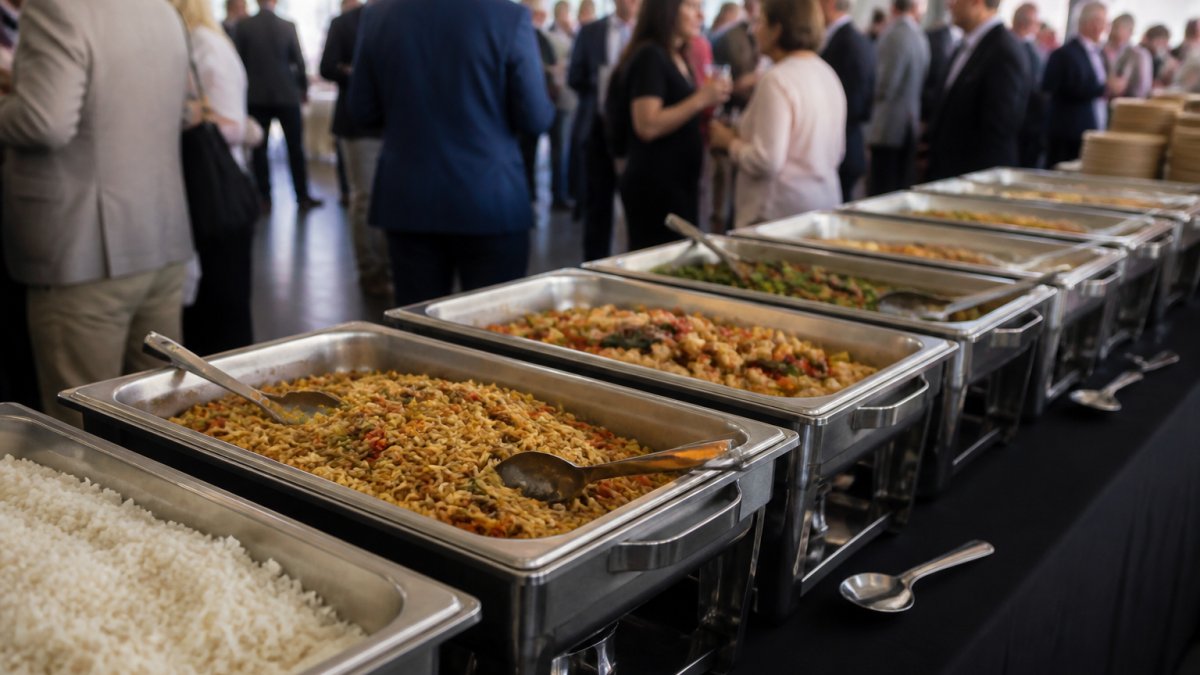
- Buffet and food trailer service suit large groups because they feed high volumes efficiently.
- Collect dietary needs on the RSVP form and label every buffet dish clearly.
Table of Contents
- Start with Guest Numbers and Event Size Before You Call a Caterer
- How to Calculate Food Portions for a Large Event
- Build a Large Event Catering Budget Checklist
- Follow an Event Catering Timeline and Checklist
- Choose a Service Style That Works for Catering for Large Groups
- Plan Dietary Requirements, Allergens and Menu Customisation
- Catering Contract Terms to Look For Before You Sign
- Get a Quote for Catering for Large Adelaide Events
- Frequently Asked Questions
Start with Guest Numbers and Event Size Before You Call a Caterer
Australia's event catering services industry is worth an estimated $10.1 billion in 2026, according to IBISWorld's Event Catering Services in Australia Industry Analysis.
Event size is the single biggest driver of catering cost, service style and staffing. Get it wrong and everything downstream wobbles.
Start with these numbers before you pick up the phone:
- A confirmed headcount, not a rough guess
- A realistic upper limit, usually 10% above your RSVP count
- The split between adults and children
For a wedding of 80, plan for 85 to 88. For a corporate function, use your RSVP list plus a buffer.
Guest numbers decide whether a buffet, food trailer or plated service makes sense.
How to Calculate Food Portions for a Large Event
Portion planning depends on your menu, service style and how long guests will be eating. Ask your caterer how they calculate servings per person before you confirm numbers.
Portion maths gets messy at scale. Use this method: How to Calculate Catering Portions: A Step-by-Step Guide
- Count guests, then add a 10% buffer
- Decide servings per person by service style
- Multiply, then round up to the nearest full tray
- Add one extra tray for every 20 guests on popular dishes
Rice, noodles and slow-cooked dishes stretch further than premium proteins. Load the menu with them.
Watch out: under-ordering to save money is the most common large-event mistake.
Build a Large Event Catering Budget Checklist
Catering is often one of the largest line items in an event budget, so build that line item first and protect it. Everything else flexes around it.
Most budget advice stops at a checklist. The useful part is understanding how each line item scales with guest count, because that is where large events blow out. A small function and a large one do not simply multiply, staffing, equipment and delivery step up in bands.
The five cost drivers, in order of impact
- Food cost per person. Driven by service style and protein content, so the menu you choose has a direct effect on the per-head price.
- Staffing and service hours. Staffing needs depend on the service style and guest count. Ask how service hours are billed, from arrival to pack-down, so you know what a long venue access window will cost.
- Equipment hire. Chafing dishes, plates, cutlery, glassware, linen and warming equipment are often quoted separately. Ask whether hire is included or on-charged.
- Delivery, travel and site access. Distance, loading-dock access, stairs, parking permits and after-hours delivery all attract charges. A venue with poor access can add cost that never appears in the per-head price.
- Dietary-specific dishes and contingency. Allergen-free and vegan dishes often carry a small premium because they are prepared in smaller batches with separate controls. A 10% contingency for late guest changes is standard practice.
A worked example of how the numbers move
Take a 150-guest corporate dinner. If the per-head food cost is quoted at one rate, the total is not simply that rate multiplied by 150, add staffing hours, equipment hire, delivery and the dietary premium, then add contingency. Run the same exercise at 250 guests and you will usually see the per-head food cost fall slightly (bulk buying) while staffing and equipment costs rise disproportionately.
How to compare catering quotes like for like
Ask every caterer to quote against the same brief, then check each quote for these items:
- Is the per-head price inclusive of GST and staffing, or food only?
- How many service staff are included, and for how many hours?
- Is equipment hire (chafing dishes, plates, cutlery, linen) included or itemised?
A quote that answers all ten is comparable. A quote that answers five is a starting point for a conversation, not a decision.
Cost pressure is real. FLIP's Catering Statistics 2026 found that 82% of caterers expect ingredient costs to keep rising. Build that into your buffer, not your hope, and lock pricing in writing at the point of booking rather than assuming the quote holds indefinitely.
Follow an Event Catering Timeline and Checklist

Most planning guides give you a list of dates. What they miss is the sequence of decisions behind those dates, which approvals gate which bookings, and what has to be locked before the next step can start. Use this working timeline instead.
Phase 1, Brief and feasibility (6 to 12 months out)
- Confirm the venue and read its catering conditions before you shortlist caterers. Many venues hold an exclusive caterer list, cap the number of external suppliers, or charge kitchen access and bond fees.
- Set the brief: guest range, service style, budget ceiling per head, dietary mix and any cultural or religious menu requirements.
- Shortlist three caterers who have documented experience at your guest volume, ask for two recent events of a similar size, not just testimonials.
Phase 2, Menu and service design (3 to 4 months out)
- Hold a tasting. Confirm portion sizes at the tasting, not from a PDF, ask for the actual serve size per guest.
- Lock the service format (buffet, food stations, plated, food trailer) because it determines staffing ratios and equipment hire.
- Confirm whether the caterer needs kitchen access, a prep area, power, water or refrigeration on site, and whether the venue charges for any of it.
Phase 3, Numbers and dietary confirmation (6 to 8 weeks out)
- Send the dietary and allergy questionnaire with the RSVP. Collect responses in a spreadsheet with one column per requirement so the caterer can cost and plate against it.
- Confirm the guaranteed minimum headcount in writing and note the date after which reductions are still charged.
- Finalise the run sheet: arrival time, setup window, service start, speeches, late-night food and pack-down deadline.
Phase 4, Final count and payment (2 to 3 weeks out)
- Submit the final headcount on the contract date. Most caterers bill on the guaranteed number, not the actual attendance, so build your 10% buffer into the guaranteed figure.
- Confirm the payment schedule and any bond or equipment deposit.
- Send the caterer a site plan showing entry points, parking, power locations and the buffet or station layout.
Phase 5, Week of event
- Reconfirm arrival time, access code, loading dock booking and onsite contact.
- Confirm equipment delivery and pick-up windows with the hire company.
- Send a final dietary summary and a copy of the run sheet to both the caterer and the venue.
Phase 6, Day of event
- Nominate one person as the caterer's single point of contact. Multiple decision-makers on the day slow service down.
- Check buffet replenishment at the halfway point rather than waiting for dishes to run out.
- Confirm pack-down and rubbish removal responsibilities before the caterer leaves.
The Oslofjord case study on large-scale catering success shows the value of starting six months ahead and dividing the room into zones. That zoning approach keeps service fast when guest numbers climb, and it is worth adopting even for events well under 200 guests.
Choose a Service Style That Works for Catering for Large Groups
Buffet and food trailer service suit large groups well, because they can feed high volumes efficiently. Plated meals look formal but need more staff and tighter timing.
Compare the main options:
| Service Style | Best For | Staffing | Pace |
|---|---|---|---|
| Buffet | Weddings, community events, 80+ guests | Moderate | Fast, flexible |
| Food trailer | Festivals, outdoor events, casual functions | Low | Steady, high volume |
| Plated meals | Formal weddings, corporate dinners | High | Slower, structured |
| Food stations | Cocktail events, mixed menus | Moderate | Interactive |
| Canapés | Boardroom catering, cocktail hours | Moderate | Grazing |
Buffet service lets guests choose their own portions and dietary options. A food trailer brings street-food energy and works well outdoors. Food Trailer vs Buffet Catering: Which is Right for Your Adelaide Event?
Plan Dietary Requirements, Allergens and Menu Customisation
Ask every guest about dietary needs at the RSVP stage, not the week before. Allergen management is a food safety issue, not a courtesy.
Get allergen management right early, as it is a food safety matter. How to Cater for Gluten-Free Guests: A Complete Guide
Cover these bases:
- Collect dietary needs on the RSVP form
- Flag gluten-free, dairy-free, vegan and nut allergies separately
- Confirm cross-contamination controls with your caterer
Customised menus handle this well. Always confirm dietary suitability with your caterer rather than assuming.
Catering Contract Terms to Look For Before You Sign
A catering contract should spell out headcount deadlines, payment terms, cancellation policy and exactly what is included. If a term is vague, ask before you sign.
Check these clauses:
- Final headcount date and how changes are billed
- Deposit amount and payment schedule
- Cancellation and postponement terms
Verifying a caterer's food safety and service quality takes a few practical steps before you commit.
Watch out: a contract without a clear headcount deadline leaves you exposed to surprise charges.
Get a Quote for Catering for Large Adelaide Events
Planning catering for large Adelaide events comes down to four moves: lock your guest numbers, build the budget, follow the timeline, and confirm the contract. Do those and the food becomes the easy part.
At Ninin's Indo Street Food, we've catered weddings, corporate functions and community festivals since 2007.
If you're weighing up a cheaper quote, ask what it actually includes. Portion size, staffing and reliability are where the real difference shows.
Frequently Asked Questions
How much food should I order for a large event?
Work from confirmed guest numbers rather than invitations sent, then add a buffer for no-shows and extra servings. For a buffet or food trailer service, plan on guests returning for a second plate, so order generously on the mains and slightly less on desserts. Ask your caterer how they calculate portions per person and whether their quote assumes a set number of servings. Ninin's builds packages around your confirmed numbers, and pricing depends on quantity, dates and service style, so request a quote with your final headcount.
How do I calculate catering portions per person?
Start with your confirmed guest count, then apply a per-person serving figure for each dish and multiply across the menu. A canapé-only cocktail event needs more pieces per person than a seated buffet because guests graze over a longer period. Factor in dietary requirements separately so gluten-free and vegan guests get full portions, not leftovers. Accurate portion planning protects both your budget and your guests' plates.
How far in advance should I book event catering?
For large events, lock in your caterer as soon as your date and venue are confirmed, ideally several months ahead. Planning several months in advance gives time to finalise menus, dietary requirements and service logistics. Peak wedding and end-of-year function periods book out fastest. If your date is close, ask directly about availability before you build the rest of your plan around a particular caterer.
What should a catering contract include?
Look for confirmed guest numbers and the deadline for final headcount, the full menu and per-person inclusions, service style and staffing, setup and pack-down times, and delivery or venue access arrangements. Check payment terms, deposit amounts and the cancellation policy, plus how dietary requirements and allergens are handled. Confirm what happens if numbers change late and who supplies plates, cutlery and serving equipment. Get everything in writing, including any verbal promises about portion sizes or arrival times, so there are no surprises on the day.
Ready to feed a crowd without the stress? Get started with Ninin's Indo Street Food and get an instant quote for your next large event.
